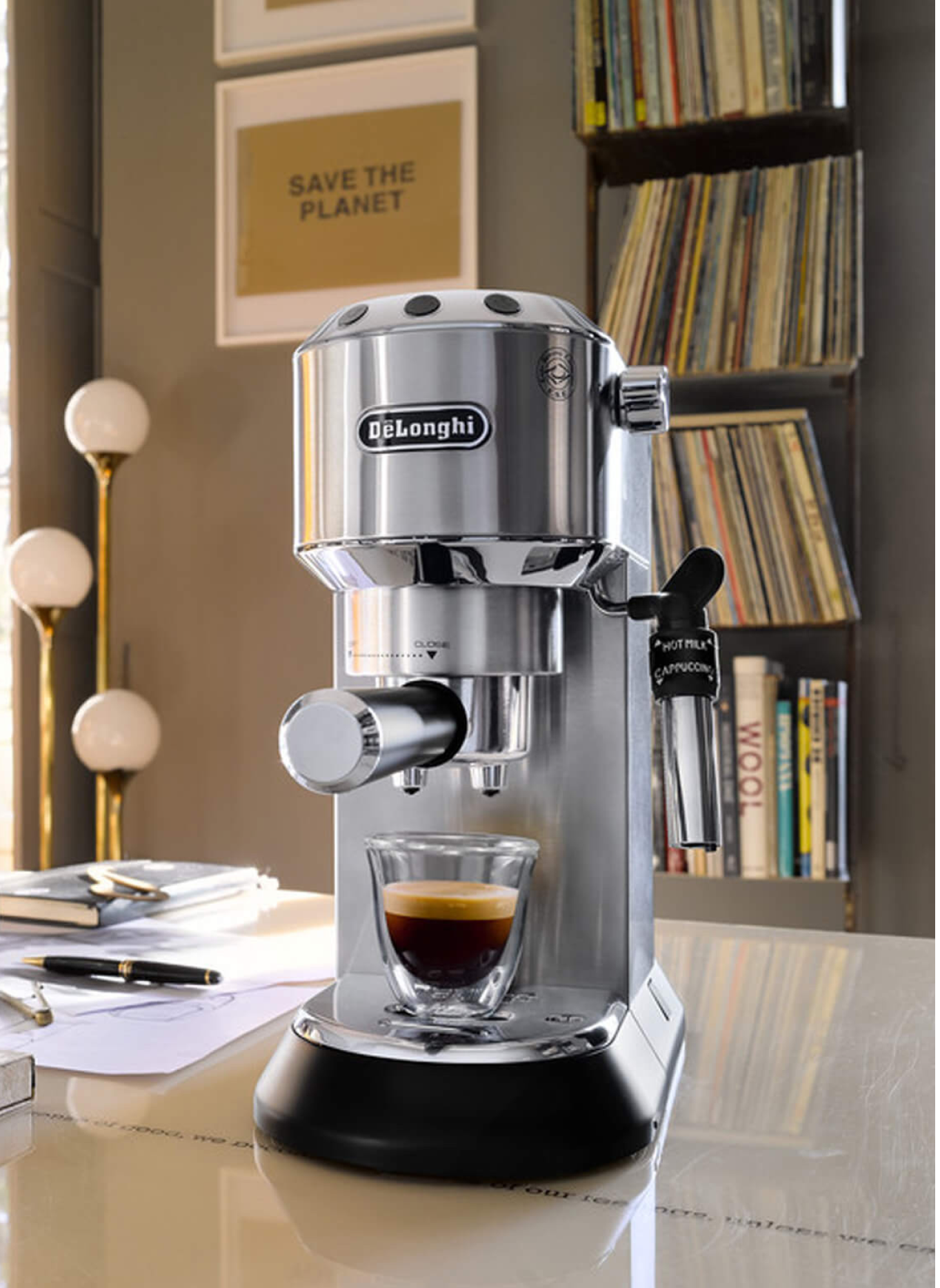
DeLonghi Dedica Review & Buyer's Guide — Compact Espresso Machine for Home Baristas Coffee Machine by Delonghi

Start at $349
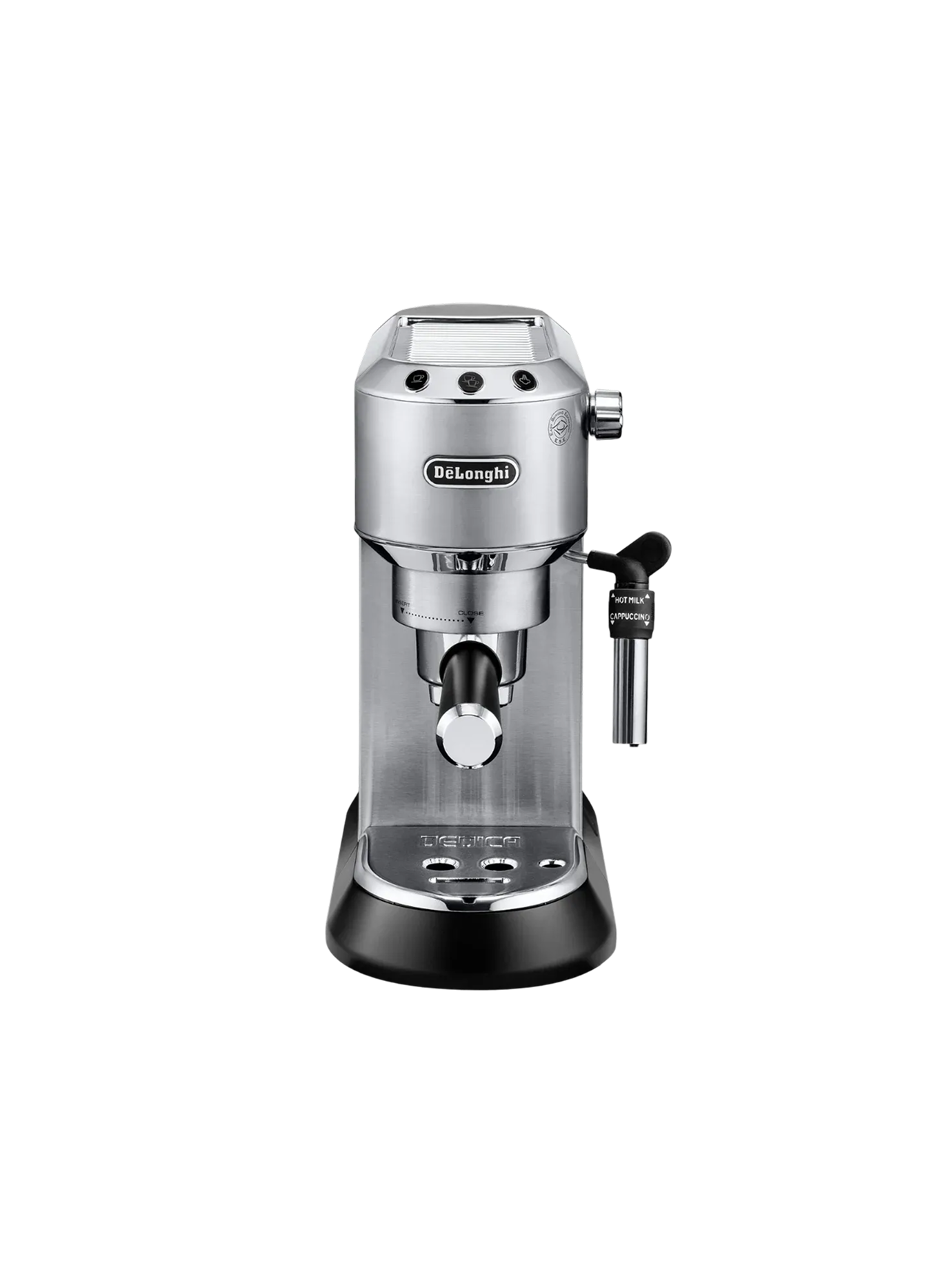
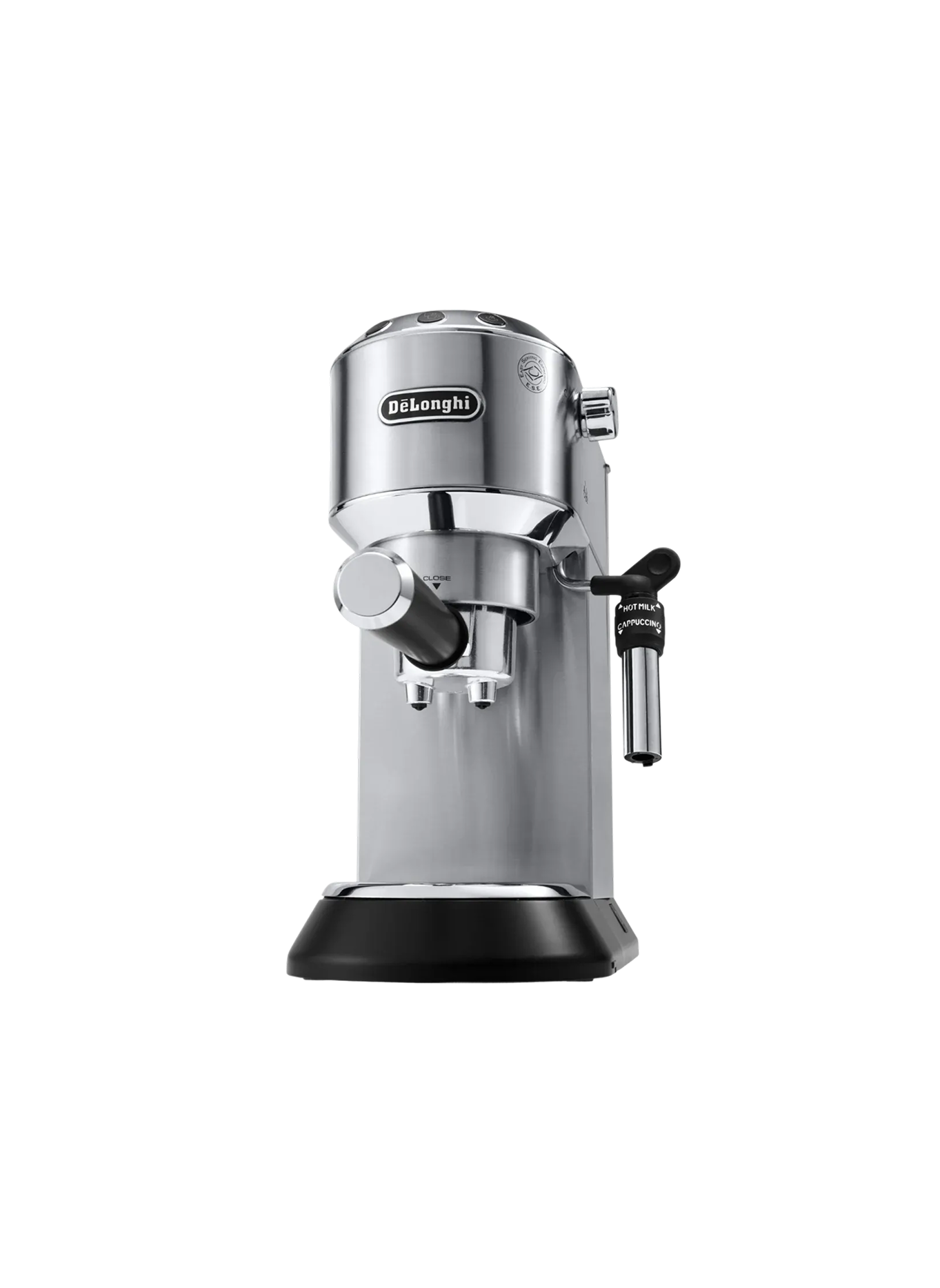
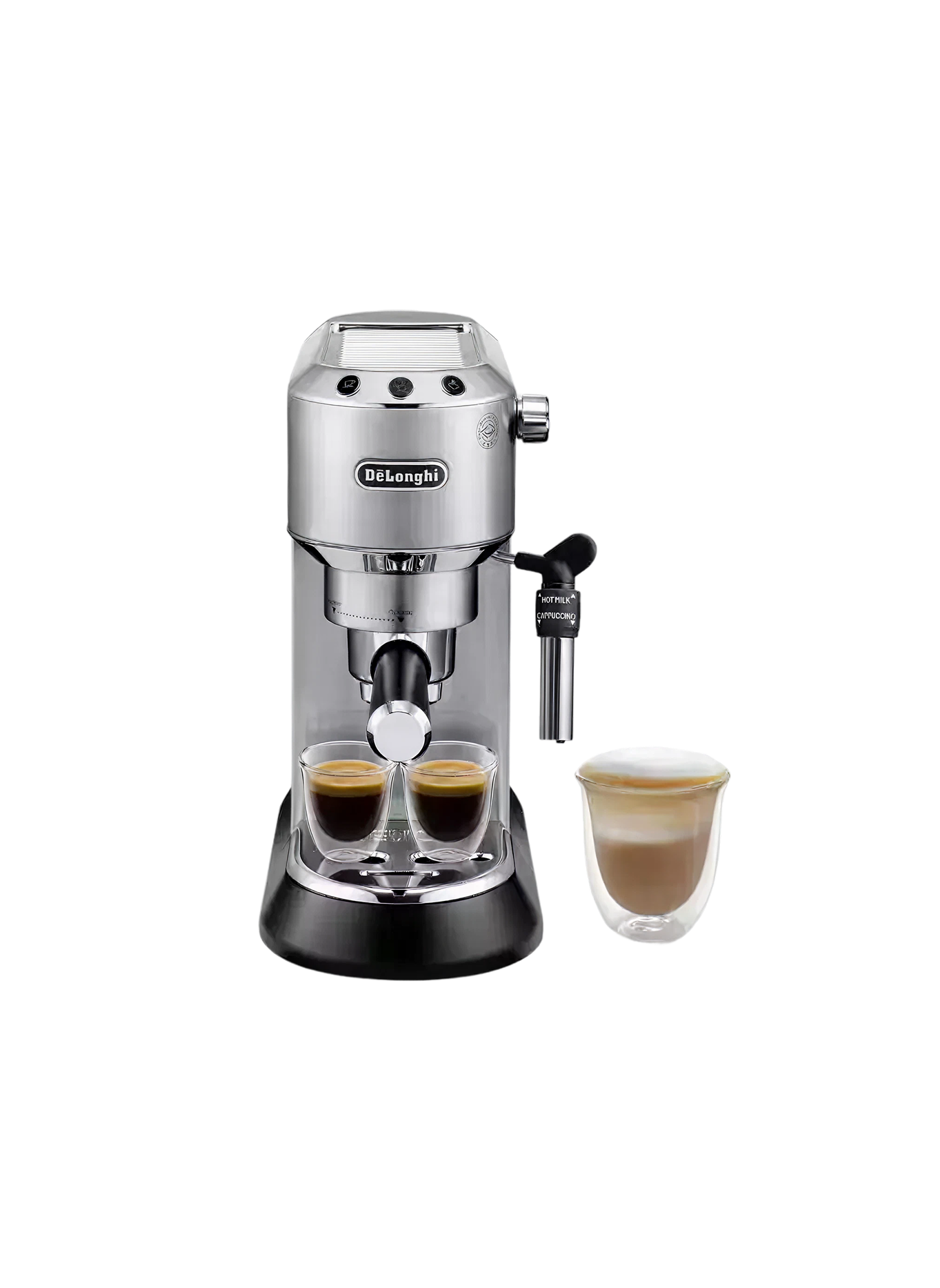
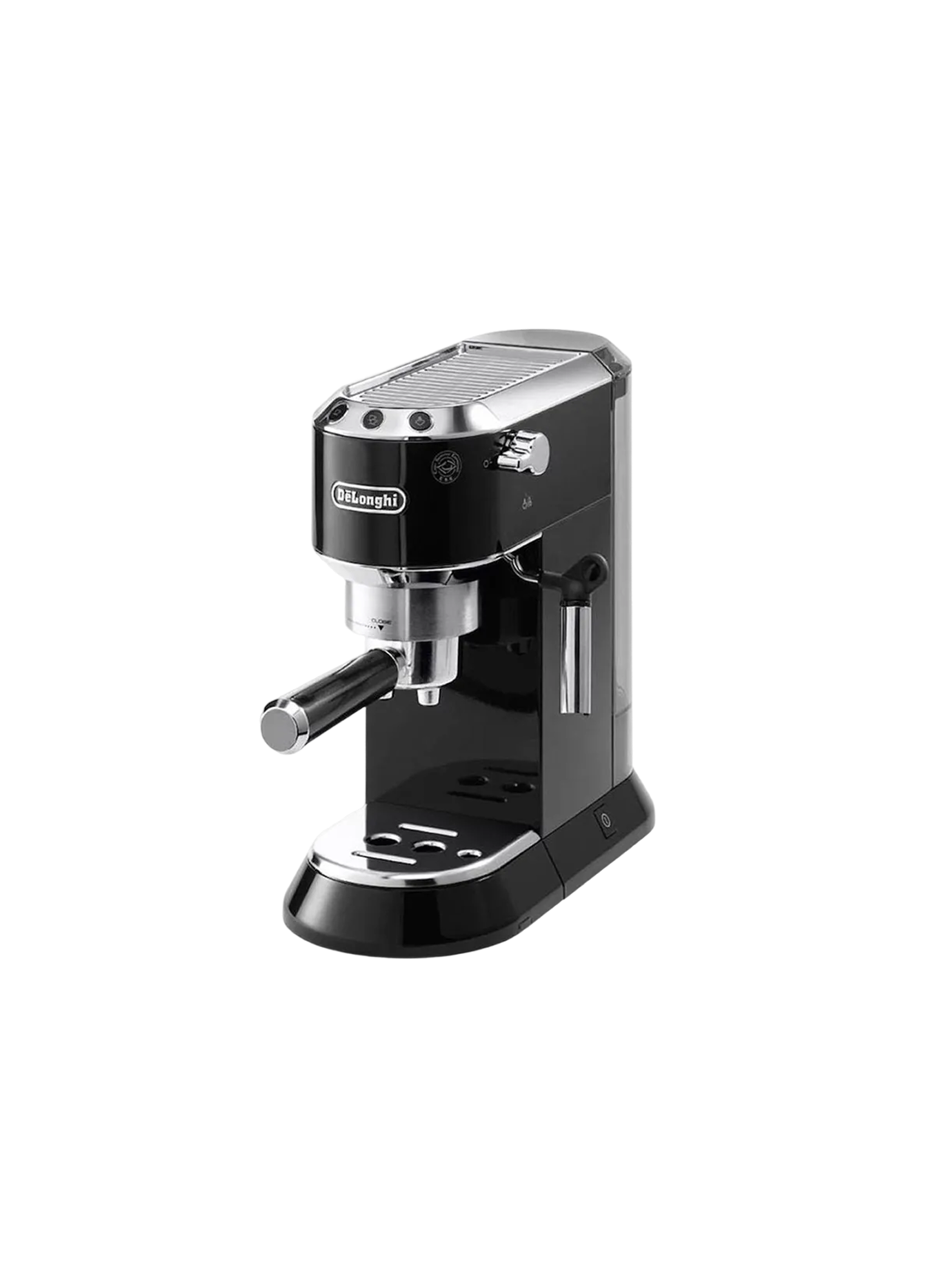
The DeLonghi Dedica is one of the most popular compact espresso machines in the world for home users who want to buy a real DeLonghi coffee machine without bulky size, high cost, or professional complexity. Built around a rigid metal body, a fast thermoblock heating system, and a 51 mm portafilter architecture, the Dedica is engineered for speed, consistency, and long-term learning.
01 The Core Strengths
of the DeLonghi Dedica
-
Compact metal chassis for stability
-
Thermoblock heating for rapid warm-up
-
Consistent 15-bar pump with steady extraction
-
51 mm portafilter with upgrade path
-
Compatible with bottomless portafilters
-
Beginner-friendly yet progression-ready architecture
02 TL ; DR DeLonghi Dedica Review Summary: Performance, Workflow & Learning Potential
The DeLonghi Dedica is a compact DeLonghi espresso machine designed for users who want fast, consistent espresso with minimal workflow complexity. Its thermoblock heating system warms water on demand instead of storing it in a boiler, allowing the machine to reach operating temperature within minutes. This makes the Dedica ideal for daily use, short routines, and spontaneous espresso sessions. The 15-bar vibratory pump delivers stable pressure, while the pressurized portafilter makes extraction forgiving enough to work with supermarket coffee, pre-ground espresso, or ESE pods. This eliminates the steep learning curve usually associated with espresso machines and allows complete beginners to obtain consistent crema and acceptable extraction without advanced technique. What truly separates the Dedica from most compact machines is its mechanical honesty. Beneath its beginner-friendly surface lies a real espresso platform: a rigid metal chassis, a stable pump curve, and a genuine 51 mm portafilter format. When paired with a good grinder, the Dedica supports non-pressurized baskets and bottomless portafilters, unlocking real espresso technique, visual extraction feedback, and significant flavor improvement. In one sentence: the DeLonghi Dedica is a fast, compact, and evolution-ready espresso machine that delivers predictable results today and a legitimate technical progression path for tomorrow.
03 DeLonghi Dedica In-Depth Review: How It Really Performs in Daily Use Our review.
At its core, the Dedica represents a fundamentally different philosophy from enthusiast-grade or professional-style espresso machines. While higher-end machines focus on thermal mass, mechanical pre-infusion, and long extraction curves shaped by heavy brewing chambers, the Dedica prioritizes speed, accessibility, and workflow predictability. It is engineered not for barista purism, but for consistent results with low demand on time, learning, or counter space.
The thermoblock system defines this experience. Unlike a traditional boiler, which heats and stores a body of water, a thermoblock flash-heats water as it travels through narrow metal channels. This allows the Dedica to reach operational temperature quickly, reduce energy consumption, and adapt to short brewing sessions. In practice, this means a user can turn the machine on, prepare a dose, and be pulling a shot within minutes — a workflow aligned with tight morning schedules and spontaneous espresso cravings. While thermal stability does not match heavy-group machines, the system remains stable enough for one or two shots in succession, particularly when paired with a good grinder.
The combination of the 15-bar vibratory pump, pressurized baskets, and Delonghi's internal hydraulic design creates a forgiving extraction environment. Pressurized baskets regulate backpressure artificially, generating crema even with inconsistent or pre-ground coffee. For beginners, this removes the steep learning curve of grind dialing. But the real surprise is the machine's underlying potential: the Dedica's pump curve is stable and strong enough to support non-pressurized baskets when paired with a proper grinder. This is where the machine transcends its entry-level position.
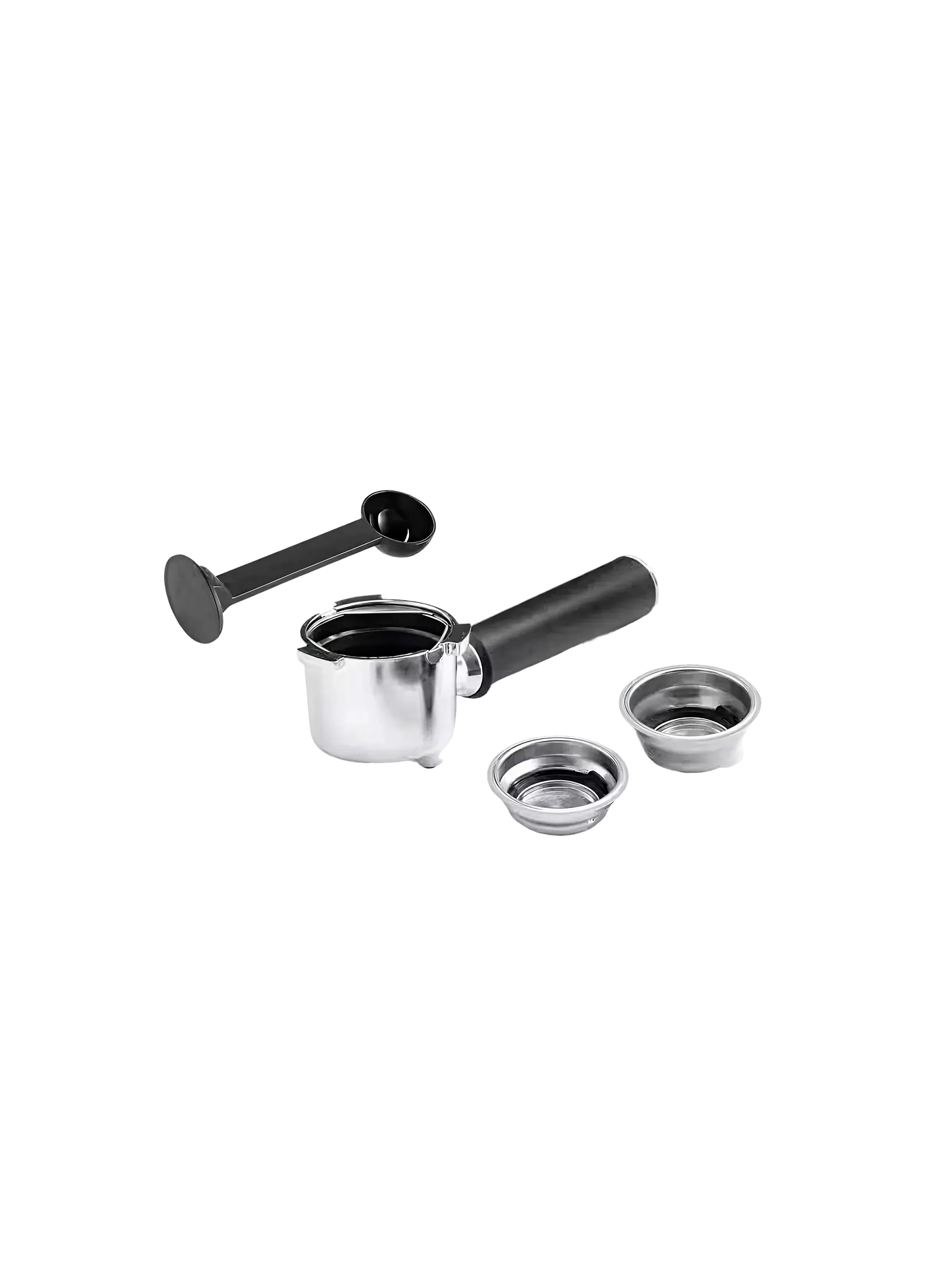
The Dedica uses a 51 mm portafilter format, a standard that benefits from a massive aftermarket ecosystem. Users can add precision baskets, distribution tools, calibrated tampers, and — most notably — bottomless portafilters. These accessories transform the Dedica from a convenient espresso appliance into a credible learning machine. A bottomless portafilter exposes channeling, distribution flaws, grind inconsistencies, and tamping errors. It eliminates the pressure assistance of pressurized baskets, meaning that extraction performance depends on the user's skill and grinder accuracy. For beginners wishing to evolve, this hybrid capability is invaluable.
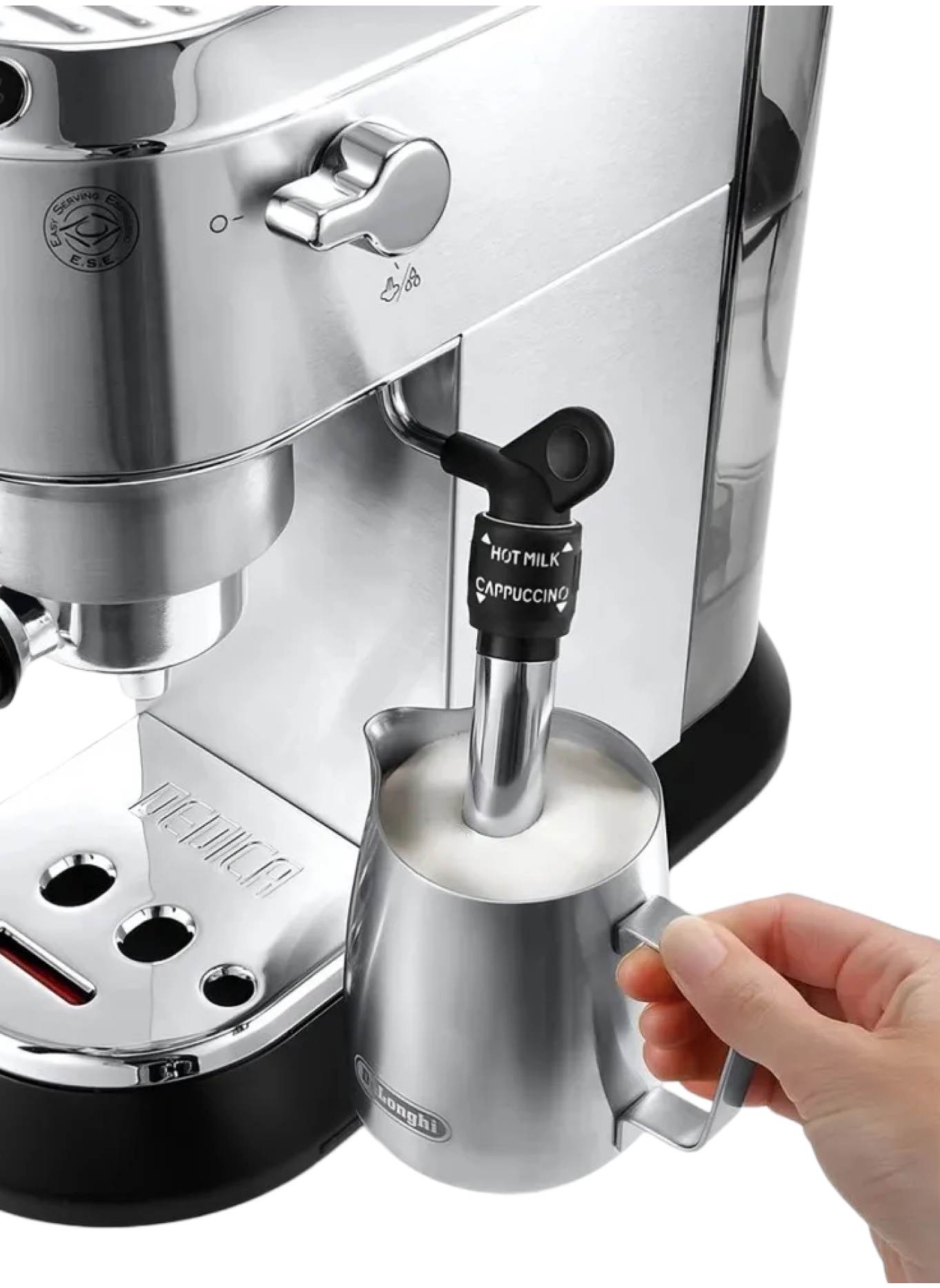
The machine's construction further supports long-term daily use. The metal chassis provides rigidity absent in many plastic-bodied competitors. The removable drip tray, the straightforward water path, and the easily serviced steam wand all contribute to a maintenance-friendly design. Milk preparation through the Adjustable Cappuccino System offers stable airflow and predictable steaming behavior, producing cappuccino-style foam with enough consistency for daily drinks and early-stage latte art practice.
Ultimately, the Dedica is honest in its purpose. It is not pretending to be a professional machine, nor does it attempt to hide its engineering constraints. Its value lies in its balanced execution: predictable behavior, solid construction, upgrade potential, and workflow simplicity. For anyone seeking a first espresso machine that will not limit them as they progress, the Dedica remains one of the most thoughtfully engineered small-format machines available.
04
Inside the DeLonghi Dedica: Thermoblock, Pump, Portafilter & Build Quality
Features & Benefits
Before analyzing individual components, it's important to understand the Dedica as a mechanical ecosystem. Its architecture is deliberately lightweight: a thermoblock, a vibratory pump, a 51 mm portafilter assembly, and a compact metal frame. Every element is optimized to reduce warm-up time, simplify extraction, and provide an approachable workflow for users without espresso experience. Yet this simplicity does not prevent depth; the machine's engineering is precise enough to support more advanced usage when equipped with the right accessories. Below is an in-depth examination of each component, what it is, how it works, and how it affects daily performance.
Thermoblock Heating System
A thermoblock is a heated metal block with narrow water channels running through it. This design heats water on demand rather than storing it, producing rapid warm-up and energy efficiency. The Dedica uses this architecture to offer near-instant readiness — a key advantage in daily use. In practice, this brings several user-level benefits: Rapid startup means espresso becomes an immediate ritual rather than a scheduled one. Consistent per-shot heating ensures stable temperature for single extractions. Lower thermal inertia allows quick transitions between brewing and steaming. Reduced limescale accumulation due to smaller internal water volume. While the thermoblock lacks the thermal stability required for advanced temp profiling, its responsive behavior suits the Dedica's intended workflow: compact, fast, and repeatable. Beginners benefit from predictable heat output; advanced users can still manage temperature through flushing and workflow timing.
15-Bar Vibratory Pump
The pump is the heart of the extraction cycle. Although rated at 15 bars, real brewing pressure stabilizes around traditional espresso levels because the portafilter — especially non-pressurized baskets — regulates backpressure. Vibratory pumps operate through electromagnetic oscillation, producing pulsed water movement. For the user, this means: Stable pressure delivery even in a compact machine. Predictable flow behavior that pairs well with both pressurized and non-pressurized baskets. Audible feedback, allowing the user to 'read' the shot through sound. With the stock pressurized baskets, the pump compensates for inconsistent grind size. But when paired with a good grinder and a bottomless portafilter, the Dedica reveals its underlying engineering quality: pressure remains stable and extraction curves become significantly cleaner, enabling café-like results.
1.1 L Removable Water Reservoir
The reservoir is designed for practicality. Its capacity supports multiple drinks without constant refilling, and its removability simplifies descaling and cleaning. Why this matters: Clean water pathways reduce bitterness and instability. Easy removal encourages better maintenance habits. Consistent water intake ensures steady pump performance. For a thermoblock system, clean water is crucial because the internal channels are narrow. The removable tank makes this maintenance far easier than on machines with fixed reservoirs.
Adjustable Cappuccino System
This system introduces air into the milk using a mechanical valve, providing a controlled and beginner-friendly way to produce foam. The design allows users to choose between more aerated milk (cappuccino) or denser milk (latte). Practical consequences: Predictable foam structure even with inexperienced technique. Smoother learning curve for milk steaming. Stable thermal behavior, making it easier to avoid scalding. While not as powerful as commercial steam wands, its consistency and mechanical simplicity make it ideal for daily lattes and cappuccinos.
Removable Drip Tray
The drip tray features two levels: the main platform and a lowered mode for tall cups. Benefits: Versatility for americanos, lattes, and travel mugs. Easy cleaning encourages daily maintenance. Stable cup placement reduces knock-induced spills. These small design elements significantly improve daily convenience.
ESE Pod Compatibility
ESE pods are pre-dosed, pre-tamped coffee packs that standardize extraction. Why this matters: Zero dial-in required. Highly consistent results. Minimal cleanup. This makes the Dedica viable even for users who do not want a grinder — at least initially.
Metal Body Construction
The metal chassis is one of the Dedica's most underrated qualities. It contributes durability, vibration damping, and structural rigidity. User benefits include: Stable portafilter lock-in. Cleaner extraction due to reduced micro-vibrations. Longer lifespan than plastic-bodied competitors. This solidity is essential when transitioning to bottomless portafilters and precision tampers.
Compact Dimensions & Weight
At 149 × 330 × 305 mm, the Dedica fits anywhere. Despite its light weight (5.48 kg), the metal frame prevents instability during brewing. In daily life: Perfect for small kitchens or shared spaces. Highly portable, yet stable enough for serious use. Allows a complete espresso setup on very limited counters. The compact size, combined with serious upgrade potential, is what makes the Dedica uniquely attractive.
51 MM Portafilter Ecosystem & Evolution Potential
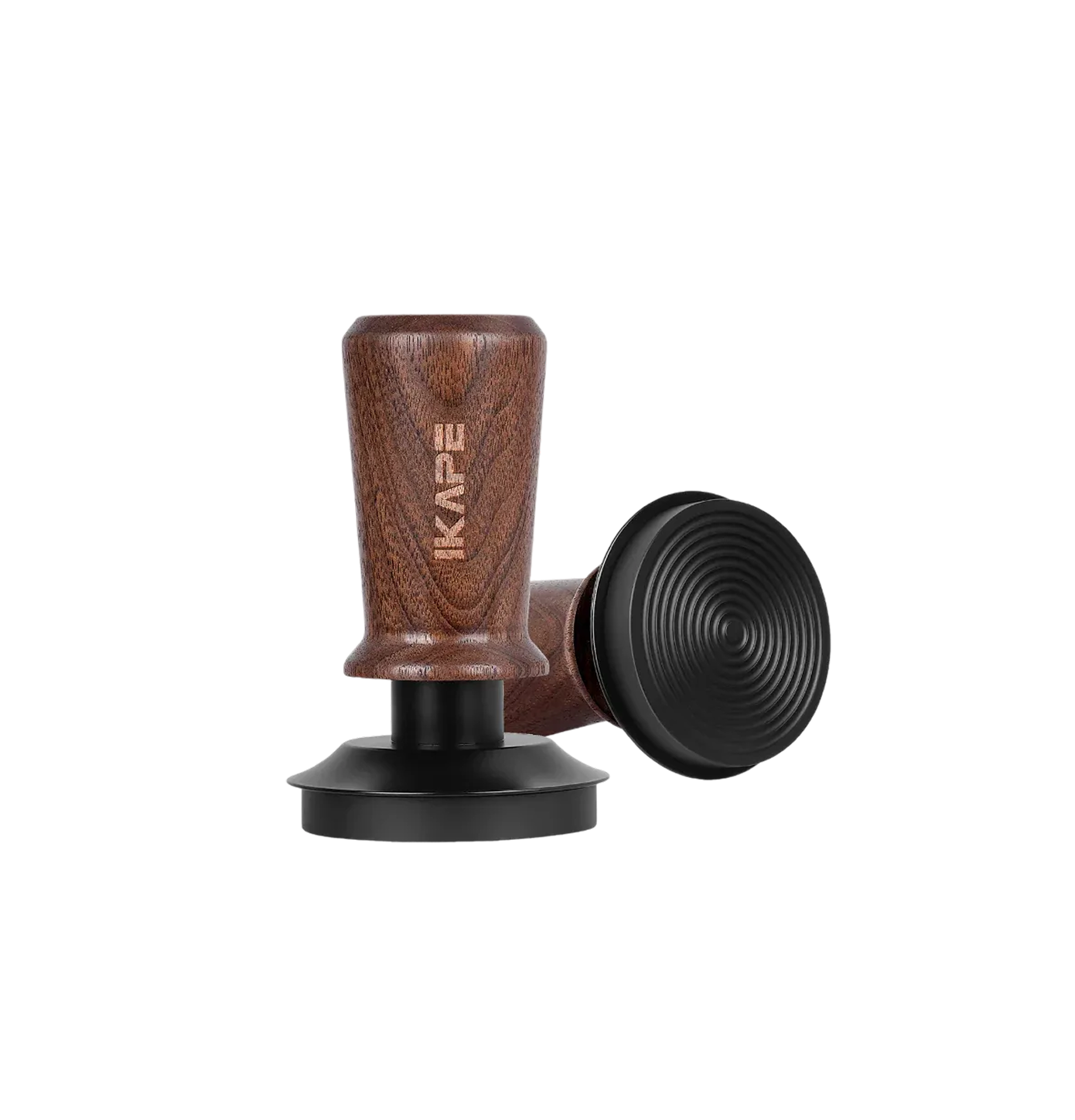
This is where the Dedica becomes far more than an entry-level machine. The 51 mm standard unlocks an enormous ecosystem of aftermarket accessories: Bottomless portafilters. Precision non-pressurized baskets. Dosing rings. Calibrated tampers. WDT tools. Puck screens. Distribution tools. All easily available on Amazon and specialty coffee retailers. For the user, this means the Dedica is not a dead-end machine. It evolves with your skill level: Beginner phase: pressurized baskets + pre-ground or basic grinder → easy crema, forgiving extractions. Intermediate phase: non-pressurized baskets + better grinder → more control, real espresso flavor. Advanced phase: bottomless portafilter → visible extraction, ability to diagnose channeling, significant improvement of technique. This progression path is rare in the compact machine category. It is what makes the Dedica a hybrid: beginner-friendly yet capable of supporting professional-style learning.
05
DeLonghi Dedica Real-World Performance: Espresso, Milk & Back-to-Back Shots
Real-World Performance
Disciplined Daily Use
The Dedica requires little preparation to deliver consistent results. Turn it on, grind or dose coffee, and the machine is ready. The thermoblock reaches temperature quickly, making it ideal for short morning routines. Once heated, the machine maintains predictable behavior for single or back-to-back shots. Temperature stability is modest due to the lightweight group, but in practical use this matters far less for beginners. Consistency remains high when workflow is steady: same dose, same grind, same tamp, same waiting time. Daily performance is defined by: Speed. Predictability. Straightforward extraction logic. Minimal maintenance overhead. For households, offices, or users who want espresso without complexity, this reliability is essential.
Back-to-Back Shots — Thermoblock Behavior
The Dedica handles sequential shots better than many compact machines. The thermoblock reheats rapidly between extractions, and the pump maintains stable pressure. However: The group head does not store heat, so temperature may drift slightly. A brief flush stabilizes thermal conditions. With a good grinder and non-pressurized baskets, back-to-back shots become noticeably more consistent.
Cappuccinos and Lattes
Steaming performance is not powerful, but it is stable. Milk foams gradually, allowing beginners to practice technique. Daily benefits: Gentle steam curve reduces risk of overheating. Air-intake valve standardizes foam creation. Reliable results for cappuccinos. Users pursuing advanced latte art will outgrow the system eventually, but for most households it is entirely sufficient.
Technical Progression & Skill Development
This is where the Dedica stands out uniquely. Because the machine is compatible with both pressurized and non-pressurized systems, it becomes a platform for gradual learning: Learn tamping basics. Observe extraction behavior with a bottomless portafilter. Improve grind consistency. Refine puck preparation through distribution tools. This progression is not possible with most thermoblocks. The Dedica's pressure stability actually supports true espresso technique.
A Superb Machine for Learning & Evolving Through Portafilter Options
When paired with a bottomless portafilter, the Dedica becomes a teaching instrument. The user can see: channeling, uneven flow, micro-sprays, hollow pucks, grind inconsistency, tamping imperfections. This visual feedback accelerates learning dramatically. With a quality grinder, the Dedica begins producing extractions that approach traditional espresso in clarity and balance. The result is a machine that meets you where you are — beginner or enthusiast — and grows with you as skill improves.
06
DeLonghi Dedica vs Competitors: Bambino, Barista Express, Gaggia, Silvia
Comparisons
DeLonghi Dedica vs Breville / Sage Bambino — Automation vs Manual Learning
La comparaison entre la Dedica et le Bambino repose avant tout sur deux visions très différentes de la chauffe, de la stabilité thermique et de la philosophie d'automatisation. Le Bambino utilise un thermocoil plus moderne, capable de stabiliser sa température plus rapidement et de limiter les fluctuations lors des shots consécutifs. Cela lui donne un avantage objectif pour les extractions répétées et pour les utilisateurs qui souhaitent une constance immédiate sans apprentissage du comportement thermique. De plus, les versions Bambino Plus ajoutent un système de texturisation automatique du lait, extrêmement performant pour ceux qui veulent des résultats homogènes sans apprendre la technique du lait. La Dedica, en revanche, assume une architecture plus simple, moins assistée, et finalement plus transparente. Son thermoblock est moins stable, mais il chauffe plus vite et laisse au barista la possibilité d'apprendre le rôle de la température, du flush, de la synchronisation et de la préparation du puck. Le Bambino est un appareil qui délivre rapidement un bon résultat, mais il masque une partie des variables derrière l'automatisation, alors que la Dedica expose les erreurs, les incohérences de mouture et les défauts de distribution. Pour beaucoup de débutants, c'est précisément cette transparence — enrichie par la compatibilité avec les portafilters bottomless et l'écosystème 51 mm — qui devient déterminante dans leur progression. Le choix dépend donc de la posture de l'utilisateur. Le Bambino est idéal pour ceux qui veulent une machine très stable, très rapide et qui minimise les marges d'erreur. La Dedica, elle, est parfaite pour ceux qui veulent comprendre comment un espresso fonctionne, développer une vraie technique, et disposer d'une machine suffisamment simple pour le quotidien mais suffisamment évolutive pour accompagner un apprentissage sérieux.
DeLonghi Dedica vs Breville Barista Express — Modular Setup vs All-in-One System
Le Barista Express occupe un segment hybride : c'est une machine volumineuse, intégrant un moulin conique interne, offrant davantage de contrôle direct sur la pré-infusion et la manipulation du café. Sur le papier, il semble offrir plus d'options, plus de consistance et une ergonomie orientée vers l'amateur motivé. Mais la présence d'un moulin intégré change radicalement la nature de la machine. Bien qu'il soit pratique, ce moulin interne n'atteint pas la qualité d'un moulin spécialisé ; il limite la finesse de réglage, crée de la rétention et empêche l'utilisateur d'améliorer progressivement son équipement. Ainsi, l'achat du Barista Express enferme le barista dans un système autonome, complet mais difficilement extensible. La Dedica propose tout l'inverse : elle sépare entièrement la machine et le moulin, ce qui permet au barista d'améliorer son setup au fil du temps. Avec un bon moulin externe, la Dedica se transforme littéralement : pression plus stable, extraction plus propre, et possibilité d'utiliser des paniers non pressurisés avec un niveau d'exigence bien supérieur à celui permis par le moulin interne du Barista Express. Le corps métallique de la Dedica, son format compact, et surtout ses accessoires en 51 mm facilement trouvables (filtres de précision, portafilters bottomless, tampers calibrés) en font une machine modulaire, évolutive, et capable de grandes performances pour qui décide de progresser. Le Barista Express conviendra à ceux qui veulent une machine tout-en-un, plus lourde, plus stable et plus proche d'un poste espresso complet dès la sortie du carton. La Dedica, elle, séduira ceux qui veulent construire progressivement leur station de barista, choisir le moulin qui correspond à leur niveau, et évoluer vers des extractions de plus en plus fines à mesure que leur technique s'affine.
DeLonghi Dedica vs DeLonghi La Specialista — Hands-On Control vs Assisted Extraction
La Specialista représente l'approche opposée à la Dedica : elle vise la simplification maximale, l'automatisation, la répétabilité facilitée et le confort quotidien. Elle embarque des systèmes de mesure, de tassage assisté, de détecteurs de pression, et des algorithmes internes destinés à réduire la variabilité liée aux débutants. Son format est imposant, son workflow très guidé, et sa philosophie résolument orientée vers le confort plutôt que la progression technique. La Dedica, au contraire, ne masque rien : le tassage est manuel, la distribution dépend entièrement du barista, la pression réelle se révèle dans le shot, et l'extraction reflète immédiatement la qualité du moulin et la précision du geste. Malgré son prix plus bas, elle utilise une structure mécanique étonnamment solide, notamment dans le fonctionnement du thermoblock, la stabilité du châssis métallique et le comportement régulier de sa pompe. Là où La Specialista cherche à « corriger » l'utilisateur pour lui garantir un résultat constant, la Dedica lui montre exactement où se situent les erreurs et comment les éliminer. La Specialista est pertinente pour les utilisateurs cherchant une expérience presque automatique, un système qui pardonne tout et qui offre un confort total, notamment pour les familles ou les bureaux. La Dedica, quant à elle, demeure la machine de ceux qui souhaitent apprendre, s'améliorer, et progresser vers de véritables extractions barista, sans renoncer à la simplicité et à la compacité nécessaires à un usage quotidien.
DeLonghi Dedica vs Gaggia Classic — Thermoblock Speed vs Boiler Stability
La Gaggia Classic est une machine culte, souvent considérée comme la porte d'entrée vers le « vrai » espresso. Son groupe en laiton, son chauffe-eau en aluminium, son portafilter en 58 mm et sa capacité à travailler avec des pressions parfaitement calibrées en font une machine plus performante que la Dedica sur le plan strict de l'extraction. Mais cette performance se paie par une courbe d'apprentissage plus abrupte, un temps de chauffe plus long, un encombrement supérieur et une discipline quotidienne plus exigeante. La Classic n'est pas une machine que l'on « allume en passant ». Elle demande une compréhension du cycle thermique, de la stabilité du groupe, de la gestion de la vapeur, et elle requiert impérativement un très bon moulin. La Dedica offre une vision plus flexible. Elle chauffe vite, elle reste compacte, elle fonctionne immédiatement avec des paniers pressurisés, mais elle peut également évoluer vers un fonctionnement quasi « Classic » lorsqu'on lui associe un portafilter bottomless et un moulin de qualité. Son architecture thermoblock ne pourra jamais délivrer le même niveau absolu de stabilité qu'une chaudière, mais ses performances deviennent étonnamment cohérentes lorsque le barista maîtrise la préparation du puck. La Classic s'adresse à ceux qui veulent s'engager dans un espresso artisanal rigoureux dès le premier jour. La Dedica s'adresse à ceux qui veulent commencer simplement mais sans renoncer à l'option de progresser vers un vrai niveau barista au fil du temps.
DeLonghi Dedica vs Rancilio Silvia — Beginner Accessibility vs Prosumer Discipline
La Silvia est une machine conçue pour l'utilisateur prêt à s'investir pleinement dans l'apprentissage du café : chaudière en laiton, groupe pesant, puissance vapeur élevée, cadence d'extraction solide, et précision mécanique digne d'une machine semi-pro. Mais elle est aussi inflexible, exigeante en workflow, très sensible à la qualité du moulin, et moins adaptée aux routines rapides. Là où la Dedica peut être utilisée spontanément, la Silvia impose un rituel complet : chauffe longue, stabilisation du groupe, gestion du « temperature surfing », et alternance stricte entre extraction et vapeur. Objectivement, la Silvia surpasse la Dedica en potentiel d'extraction, en qualité de vapeur, et en capacité à reproduire une dynamique d'espresso proche de celle d'un café professionnel. Mais la Dedica surpasse la Silvia en accessibilité, en compacité, en modularité, en coût total d'entrée, et en capacité d'accompagner un débutant sans le submerger. Son format 51 mm, sa compatibilité avec les accessoires avancés, et sa pompe capable de soutenir des paniers non pressurisés en font une machine qui peut grandir avec son utilisateur, sans l'obliger à entrer immédiatement dans la rigueur d'une machine professionnelle. La Silvia conviendra à ceux qui veulent une machine exigeante mais capable du meilleur. La Dedica conviendra à ceux qui veulent une machine simple, progressive, flexible et suffisamment ouverte pour évoluer au rythme de leur apprentissage.
07 Pros
it's the right machine for you for
08 Cons
be aware of the following before buying
09 Should You Buy the DeLonghi Dedica? Buyer Verdict & Best Use Cases
The Dedica is a machine for users who want espresso not as a chore, but as a daily ritual rooted in simplicity, precision, and gradual mastery. It stands at an intersection rare in its category: accessible enough for complete beginners, yet mechanically open enough to accompany a user through years of progression. Many compact machines limit long-term growth because they are closed systems — unmodifiable, unresponsive to technique, and incapable of revealing the nuances of extraction. The Dedica is the opposite: its 51 mm format, pump stability, and compatibility with bottomless portafilters give it the structural honesty needed to train a barista's hand, while remaining forgiving and straightforward when used with pressurized baskets.
Buying the Dedica means embracing a machine that respects your pace. At first, it works effortlessly with pre-ground coffee or ESE pods, producing consistent crema and predictable results without demanding a grinder or elaborate workflow. But as your curiosity grows, the machine grows with you. Switching to a proper espresso grinder transforms its performance entirely: pressure stabilizes, extraction becomes cleaner, and the shift to non-pressurized baskets reveals a completely different cup profile — richer, more articulate, more faithful to the beans. When you eventually add a bottomless portafilter, the Dedica becomes an authentic training platform, exposing flaws in distribution, channeling, and puck density with a clarity usually reserved for machines far above its price class.
In daily life, the Dedica offers something few machines manage: a fusion of convenience and craft. Its thermoblock allows near-instant warm-up, making espresso possible even on tight schedules. Its metal chassis offers durability and stability in a form factor that fits any kitchen. Its workflow is fast enough for a weekday morning, but transparent enough to teach you the mechanics of a well-executed shot. It is a machine that rewards improvement without punishing inexperience, and that invites you to refine your skills without requiring you to master everything immediately.
The Dedica is not meant for users who expect professional steam power, full temperature profiling, or the precision of a heavy-group machine. It does not pretend to be a miniature café machine. Instead, it is a disciplined, well-engineered tool designed to deliver real espresso within the constraints of compact living, limited budgets, and evolving skill levels. It is honest about what it is, and that honesty is what makes it effective: a machine with enough structure to teach, enough forgiveness to welcome beginners, and enough engineering quality to remain relevant long after the first months of use.
If you value a compact footprint, reliable daily consistency, progressive learning, and the freedom to upgrade your workflow without changing machines, then the Dedica is more than just a good entry-level option. It is a long-term companion — one that transforms as you do, and one of the most intelligently balanced espresso machines in its category.
10 DeLonghi Dedica Technical Specs: Pressure, Dimensions, Power & Compatibility
11 DeLonghi Dedica FAQ: How to Use, Clean, Descale & Choose the Right Coffee
How long does the DeLonghi Dedica take to heat up?
The DeLonghi Dedica heats up in approximately 40 to 60 seconds thanks to its thermoblock heating system. Unlike boiler machines that require full thermal saturation, the thermoblock heats water on demand as it passes through internal metal channels. For optimal consistency, it is recommended to run a short blank shot before brewing to stabilize internal temperatures and the group head.
Do I need a grinder with the DeLonghi Dedica?
No, a grinder is not mandatory at the beginning. The Dedica works with ESE pods and pre-ground coffee thanks to its pressurized baskets. However, if you want to use non-pressurized baskets or a bottomless portafilter, a good espresso grinder becomes essential. Without a grinder, you remain locked into convenience mode. With a grinder, the Dedica transforms into a genuine espresso learning platform.
Can I use a bottomless portafilter with the DeLonghi Dedica?
Yes. The DeLonghi Dedica is fully compatible with 51 mm bottomless portafilters. Using one allows you to visually observe extraction behavior: channeling, uneven flow, spurting, and puck preparation flaws. This visual feedback dramatically accelerates learning and improves extraction consistency and flavor clarity over time.
Is the DeLonghi Dedica good for beginners?
Yes — it is one of the best beginner espresso machines that does not limit long-term progression. Beginners can start with pressurized baskets and pre-ground coffee, then progressively move to a grinder, non-pressurized baskets, and bottomless portafilters without ever changing the machine.
Is the steam wand powerful enough for cappuccinos and lattes?
The steam power is moderate but stable. It is perfectly suited for daily cappuccinos, lattes, and basic latte art learning. It does not match the brute force of boiler machines, but its controlled steam curve makes it more forgiving for beginners and prevents milk overheating.
How do I descale the DeLonghi Dedica?
Fill the water tank with a proper DeLonghi descaling solution diluted with water. Run several brewing cycles without coffee through the group head and steam circuit. Then rinse the tank and flush at least one full tank of clean water through the system. Regular descaling (every 2–3 months depending on water hardness) is essential to protect the thermoblock from internal scale buildup.
How do I clean the DeLonghi Dedica?
Daily: rinse the portafilter, baskets, drip tray, and purge the steam wand after each milk use. Weekly: clean the shower screen and group gasket with a soft brush. Monthly: remove oils using espresso machine cleaning products if compatible. Clean water and milk residue control are crucial for flavor stability and machine longevity.
Which coffee is best for the DeLonghi Dedica?
For beginners, medium-roast espresso blends work best because they are forgiving and produce stable crema with pressurized baskets. As you move to a grinder and non-pressurized baskets, you can explore fresher specialty beans. Avoid very light roasts unless using high-quality grinders and precise dialing.
Can I make several espresso shots in a row?
Yes. The thermoblock reheats very quickly between shots. However, because the group head has low thermal mass, a short flush between consecutive shots helps stabilize temperature and ensures consistent extraction.
Is the DeLonghi Dedica difficult to maintain?
No. Maintenance is simple and light compared to boiler machines. Regular rinsing, weekly cleaning, and periodic descaling are sufficient to keep the machine operating reliably for years.
Is the DeLonghi Dedica a real espresso machine or just a coffee maker?
It is a true espresso machine. While it offers beginner-level convenience through pressurized baskets and pods, its pump stability, 51 mm portafilter, and bottomless compatibility allow it to behave like a genuine espresso system when properly equipped.
09/10


Build Quality
& Durability
08/10
Extraction
Consistency
09/10
Upgrade
Potential
08/10
Ease of Use
& Learning
{{for-who-title-right}}
Find where to buy DeLonghi Dedica
Apply to become a reseller

DeLonghi Dedica Manufacturer
Delonghi is an Italian small appliance manufacturer specializing in coffee machines, kitchen appliances, and climate control. Founded in 1902, the company has become a global leader in home espresso machines, known for combining Italian design heritage with accessible pricing and user-friendly engineering for home baristas.