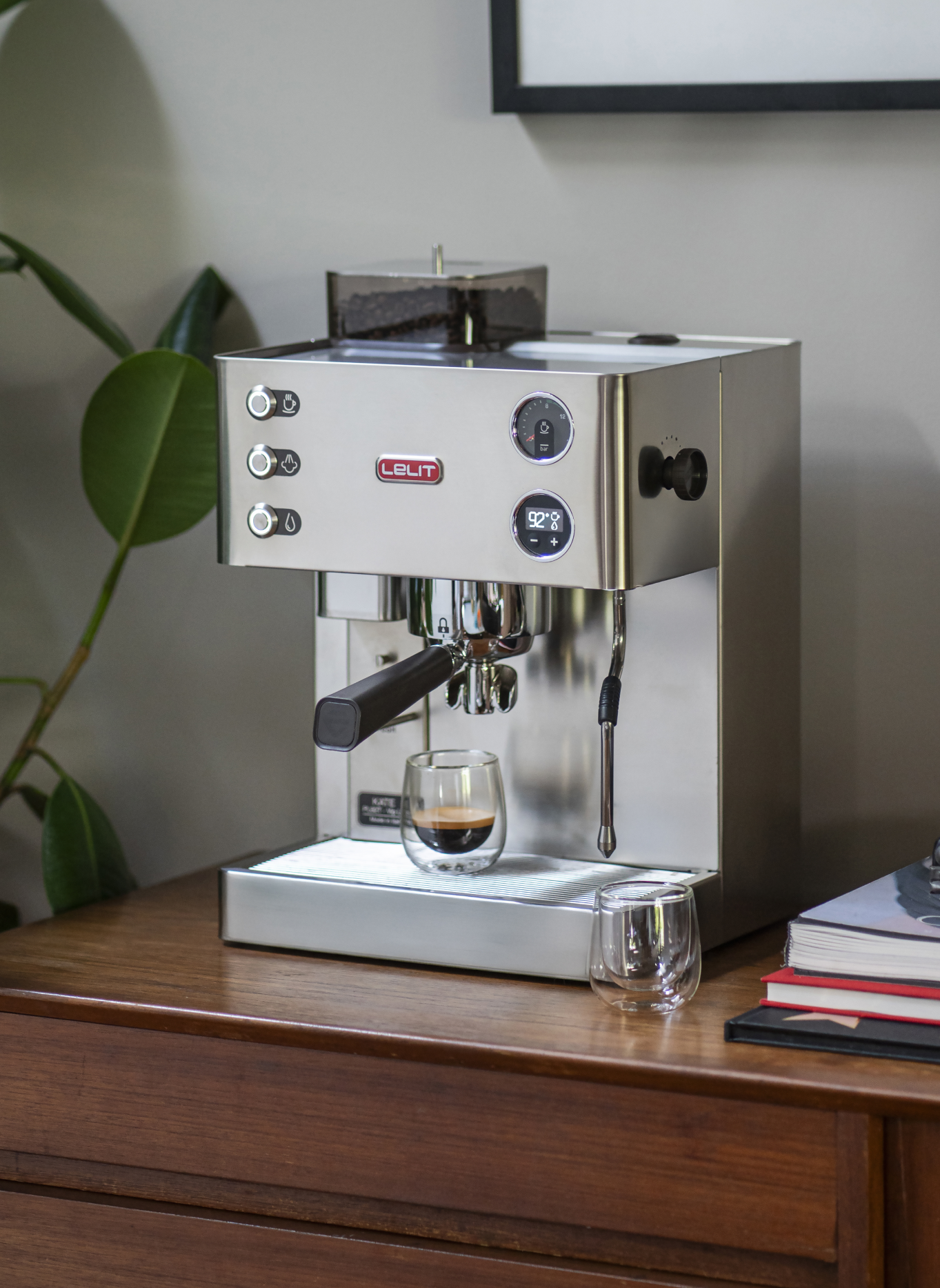
Lelit Kate PL82T Espresso Machine with Grinder (Full Expert Review) Coffee Machine by Lelit

Start at $1099
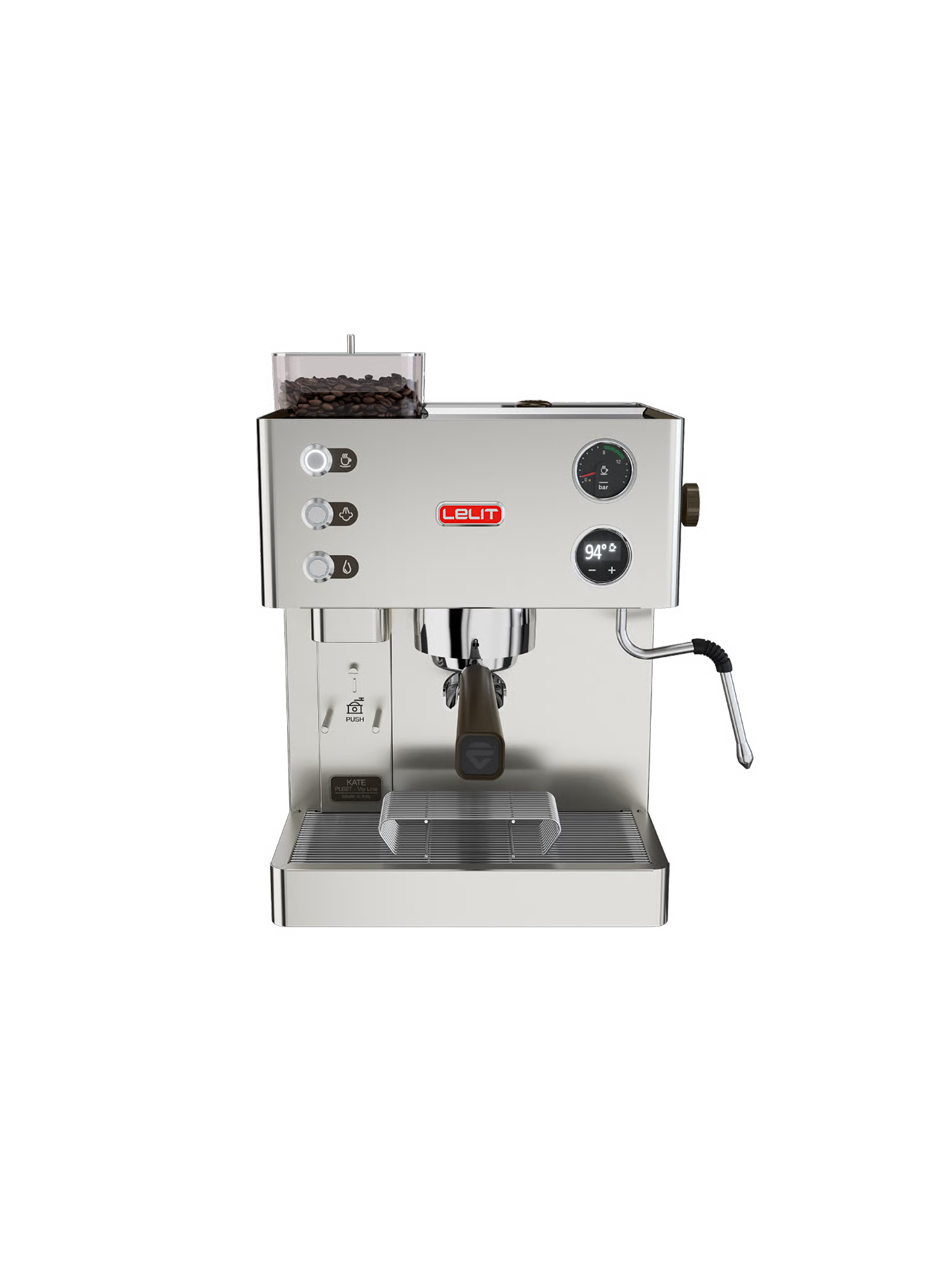
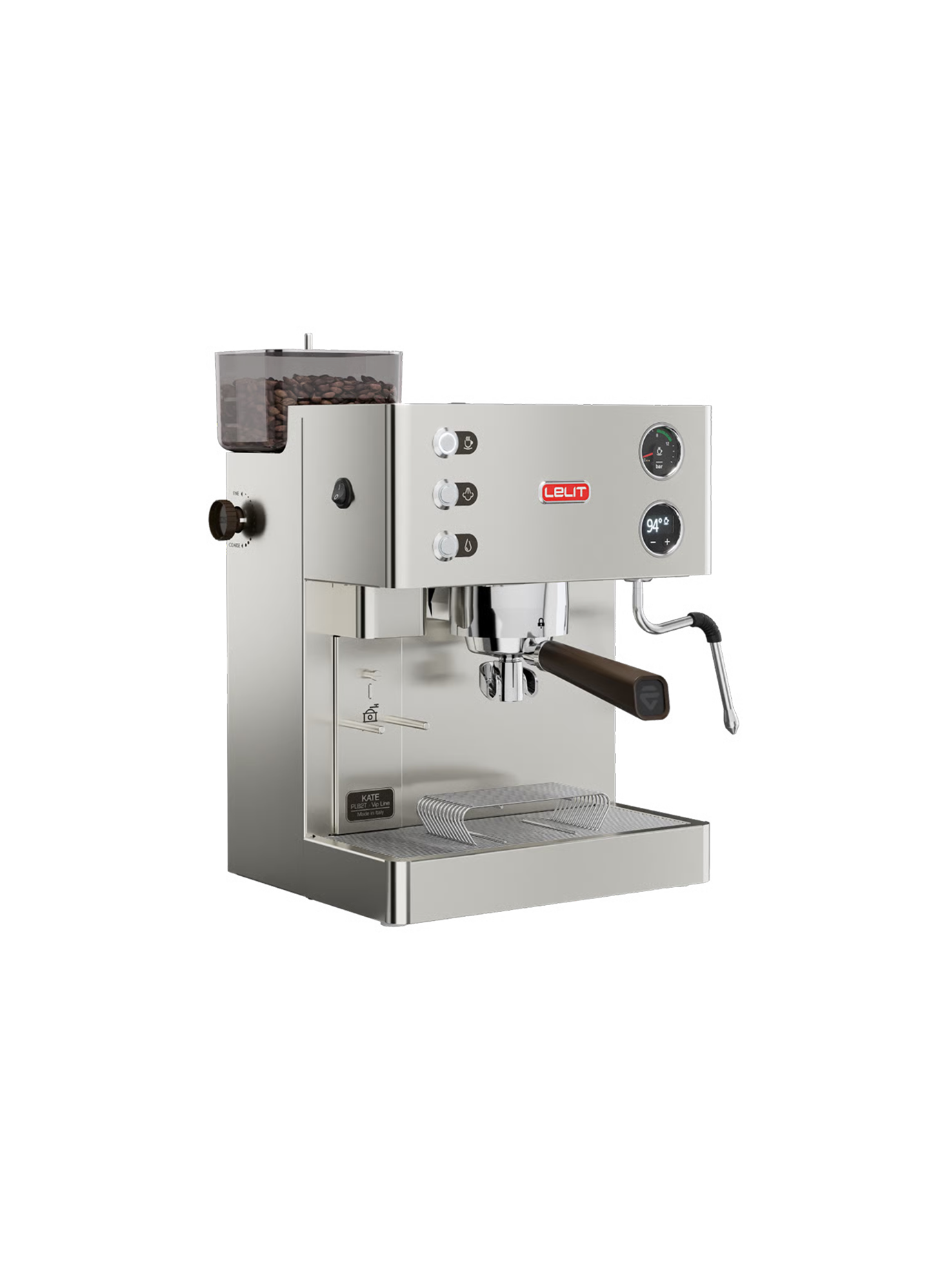
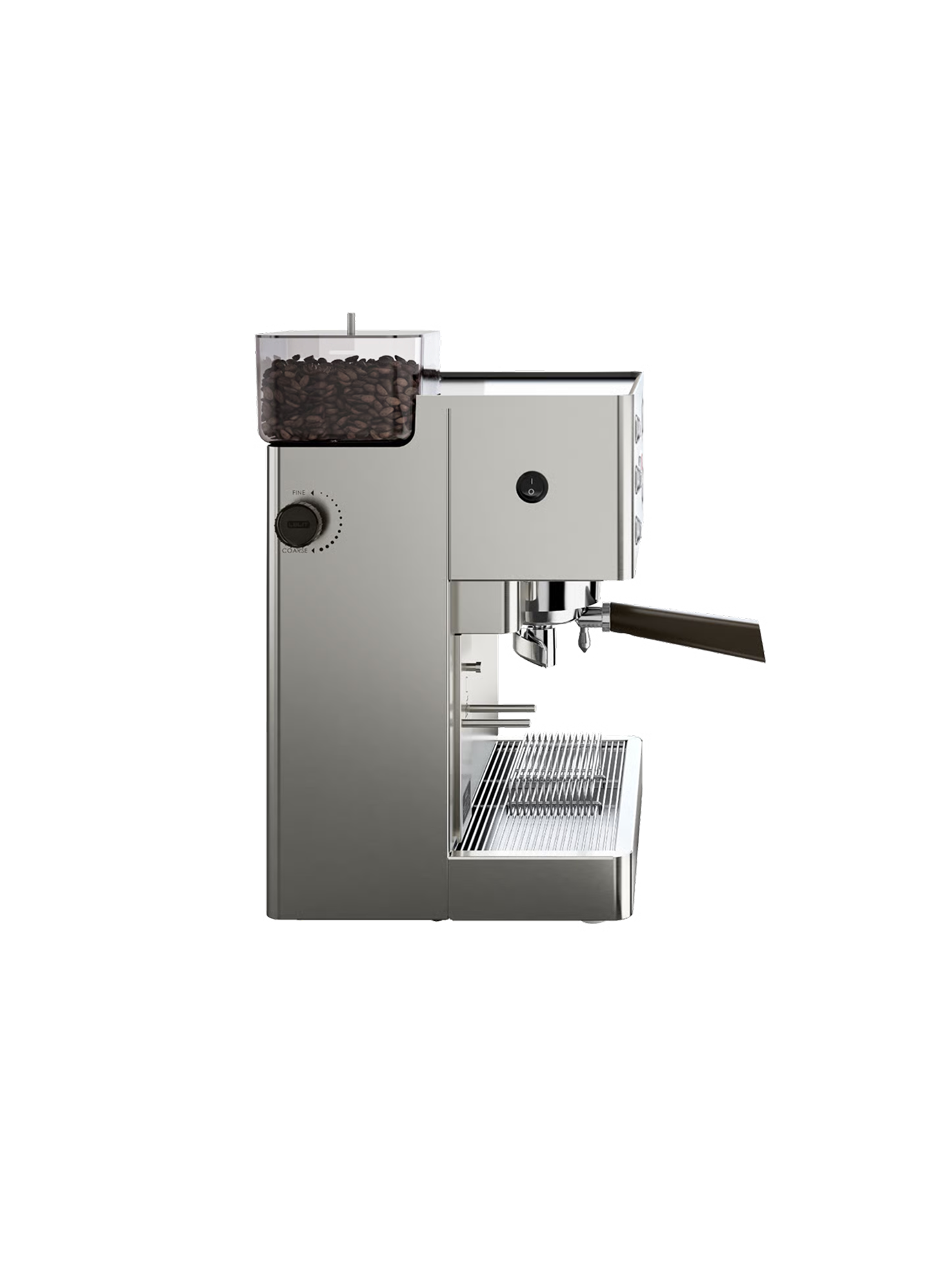
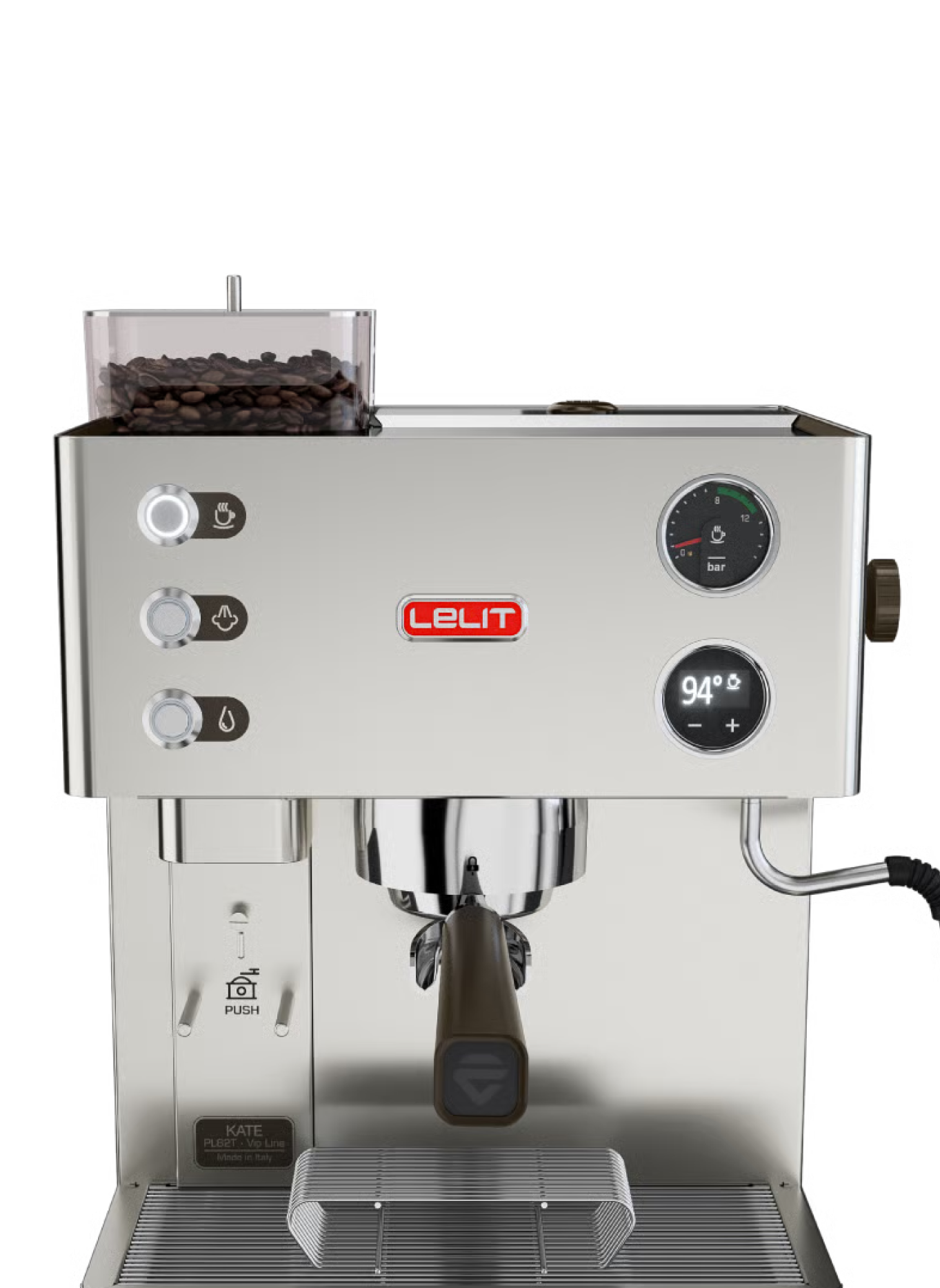
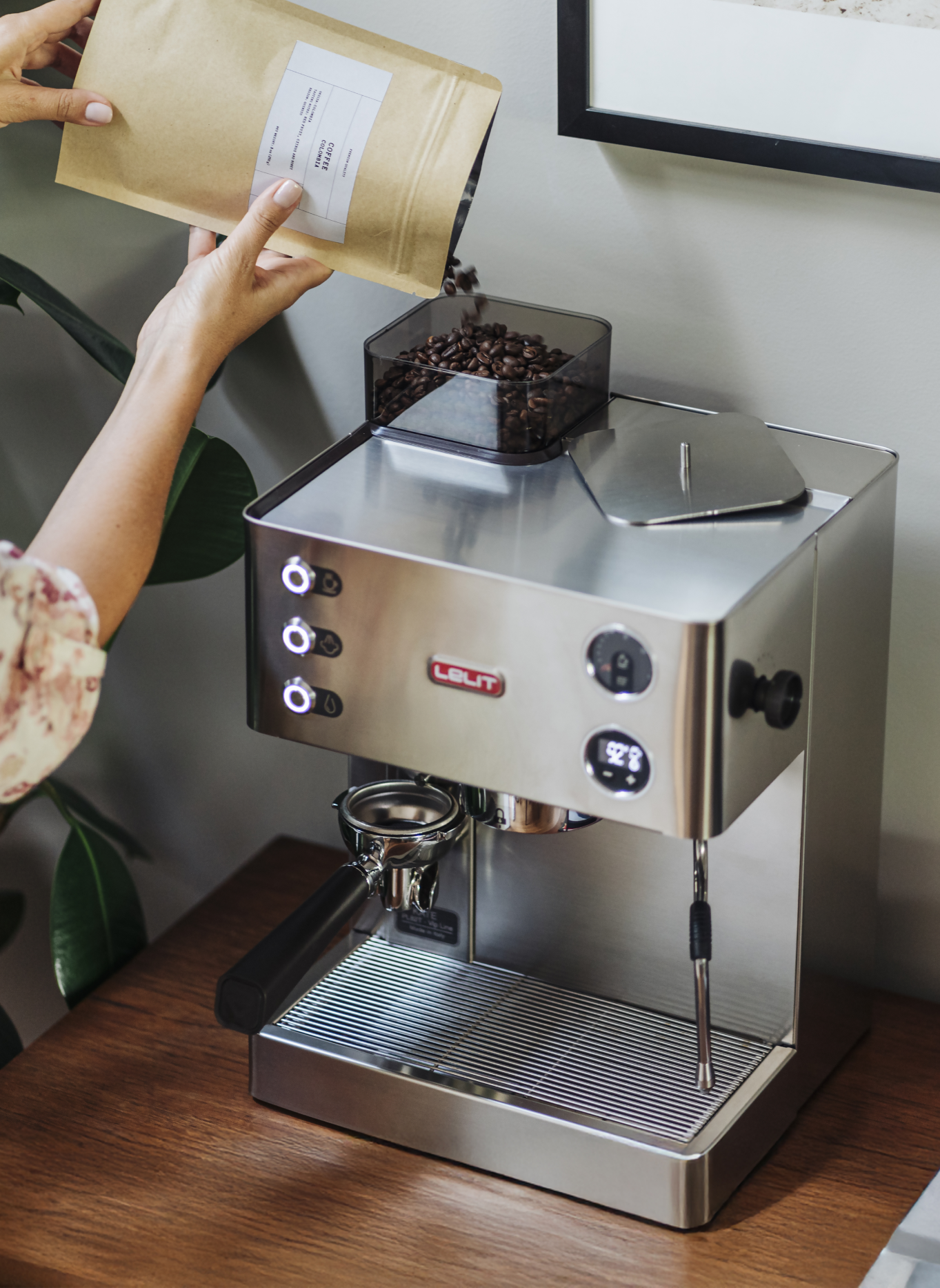
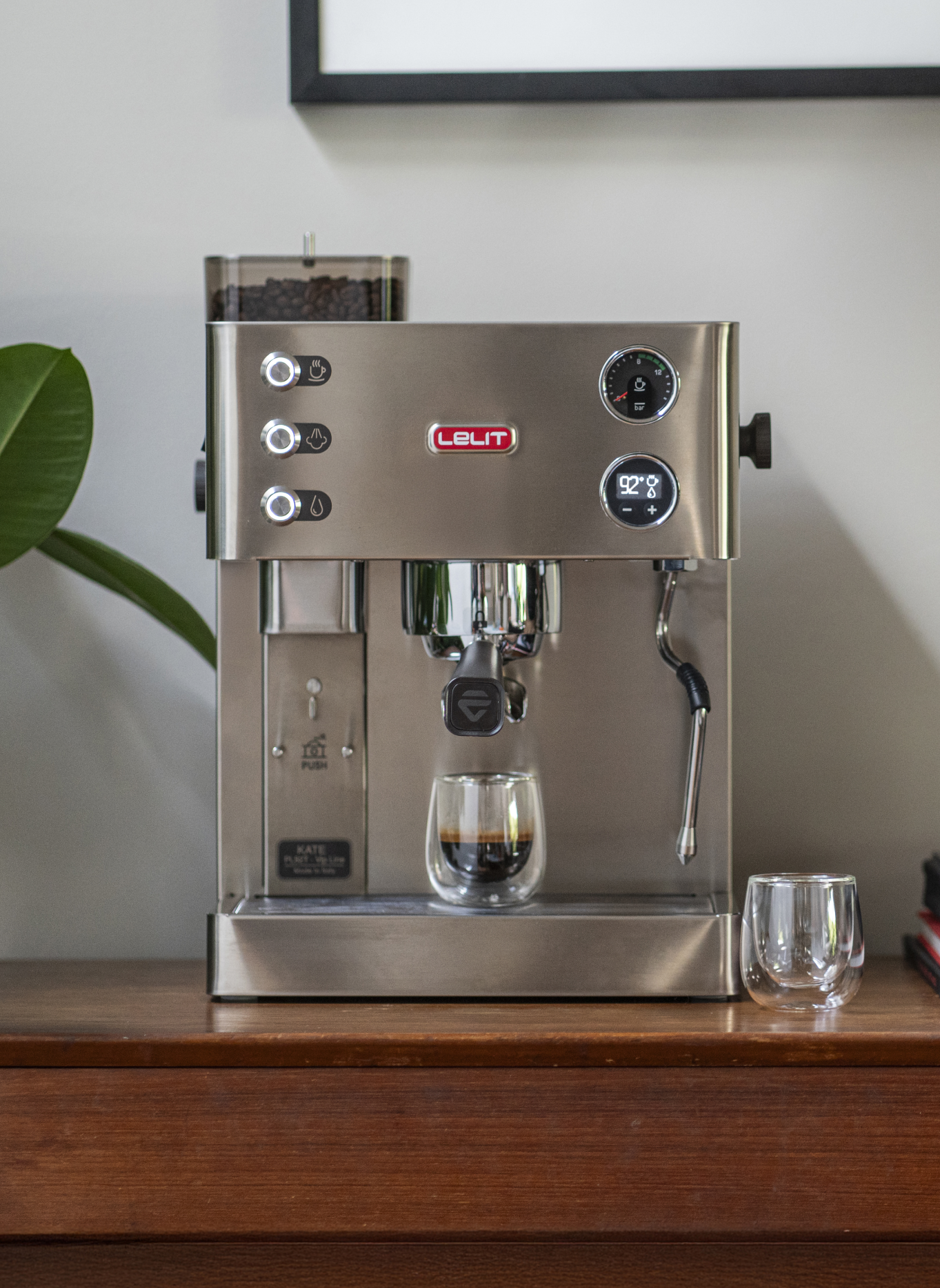
The Lelit Kate PL82T is a prosumer-grade espresso machine with grinder designed for users who want true café-style extraction without committing to a full two-machine setup. Positioned between mass-market all-in-one appliances and modular espresso systems, it combines a real 58 mm espresso group, a temperature-stable 300 ml brass boiler managed by the Lelit Control Center (LCC), and a stepless conical burr grinder inside a compact stainless-steel chassis. Unlike generic coffee machines with grinder built in, the Kate is engineered around authentic espresso mechanics: stable pressure, predictable thermal behavior, precise grinding, and full manual control. It does not automate technique — it exposes it.
01 Core Strengths of the Lelit Kate PL82T Espresso Machine with Grinder
-
Integrated grinder removes need for separate machine
-
Precise micrometric grind adjustment
-
Brass boiler for stable extractions
-
LCC for temperature and workflow control
-
Compact stainless-steel build for durability
-
Complete 58 mm ecosystem compatibility
-
Multidirectional steam wand for milk drinks
02 TL ; DR A True Espresso Machine with Grinder, Not Just a Coffee Machine with Built-In Grinder
The Lelit Kate PL82T is the rare machine that brings together two elements usually kept separate: a professional-grade grinder and a stable single-boiler espresso platform. This union is not about convenience but about coherence. The grinder's particle uniformity directly impacts extraction, and by integrating both systems, Lelit removes workflow friction while ensuring the machine reads your adjustments accurately. The brass boiler stabilizes temperature, the LCC supervises parameters, and the 38 mm conical burrset gives the user granular control over grind size. For the home barista who wants a serious tool without complex infrastructure, Kate delivers a controlled, reliable, and compact environment — capable of long-term progression and consistently excellent espresso.
03 Why the Lelit Kate Matters: Who This Espresso Machine with Grinder Is For (And Who Should Avoid It) Our review.
Mastering espresso begins with consistency: stable heat, predictable pressure, and — above all — precise grind size. Most all-in-one consumer appliances compromise on this last point by using small burrs, stepped adjustment, or inconsistent dosing. The Lelit Kate PL82T takes the opposite route. Its 38 mm conical burrs with stepless micrometric regulation create extremely fine control over particle distribution, allowing users to adjust extraction in fractions of a dial movement. Because the grinder is built directly into the machine's chassis, the workflow becomes linear: grind, tamp, extract, adjust. There is no static, no mismatch of burr geometry, no unstable dosing path. The machine becomes a single mechanical organism where every variable speaks to the next.
The 300 ml brass boiler is deliberate. Brass offers high thermal inertia and predictable heat retention, allowing the user to stabilize temperature with ease. While it is not a dual-boiler powerhouse, the Kate is engineered around controlled repetition rather than speed. Paired with a 3-way solenoid valve, extractions end cleanly with dry pucks, contributing to consistent workflow and easier cleanup. The Lelit Control Center elevates the machine beyond purely mechanical systems: the OLED display monitors brew temperature, steam temperature, shot time, and alerts such as water-tank depletion. Features like adjustable pre-infusion and programmable grinding times reflect a philosophy of transparency — the machine shows what it is doing, and why.
During repeated testing, what stands out is coherence. Every component works with the others rather than around them. The grinder is genuinely espresso-capable; the boiler stabilizes quickly; the pressure gauge gives clear feedback; the wand provides predictable steam. Kate is not pretending to be a café machine. It is an intentional home tool: stable, compact, and technically honest. It rewards users who want to understand extraction and develop long-term skill, and it avoids the fragility of high-automation systems.
04 Feature Architecture: The Integrated Grinder Explained: Why Grind Quality Defines This Espresso Machine
Before analyzing components individually, it helps to understand Kate as an integrated system. Unlike setups where the grinder and espresso machine operate as independent devices, the PL82T unifies both. This integration means less distance for coffee to travel, fewer variables between grind and extraction, and a more disciplined approach to workflow. The brass boiler stabilizes temperature, the grinder stabilizes particle size, and the LCC ensures these two pillars are predictable from shot to shot. This predictability is what ultimately raises cup quality: fewer external disruptions, more internal coherence.
38 MM Conical Burrs with Micrometric Stepless Adjustment
The grinder inside the Lelit Kate PL82T is not an accessory — it is the foundation of the machine's performance. Lelit uses 38 mm conical burrs paired with a micrometric stepless adjustment system, a configuration rarely found in compact all-in-one machines. Most integrated appliances rely on small burrs, plastic carriers, or stepped dials that limit precision. The Kate takes the opposite route: every micro-movement of the adjustment collar changes particle size with a level of granularity suited for professional espresso. This matters because grind size is the primary determinant of flow rate, solubility, and extraction balance. Finer particles increase hydraulic resistance within the coffee puck, slowing extraction and intensifying sweetness and body; coarser particles accelerate the flow, revealing acidity or reducing complexity. Conical burrs also produce a controllable bimodal distribution, yielding both fines (responsible for viscosity) and larger particles (responsible for clarity). The importance of this grinder becomes even clearer in an integrated machine. Because the burrs sit directly above the portafilter, retention is low, static is reduced, and the workflow becomes linear: grind → tamp → extract. There is no gap between devices, no inconsistency introduced by transferring grounds, and no drift from grinder-to-machine mismatch. The impact on cup quality is significant — shots become more repeatable, adjustments are more visible, and dialing-in takes fewer attempts. For beginners, this improves the learning curve dramatically; for experienced users, it provides a high-resolution instrument for fine-tuning. In a category dominated by appliances that hide imprecision through automation, the Kate offers a grinder that exposes and rewards technique.
300 ML Brass Boiler — Thermal Inertia & Brewing Stability
Lelit's choice of a 300 ml brass boiler is a technically meaningful departure from the thermoblocks commonly used in compact machines. Brass has high thermal mass and excellent heat stability, ensuring a more consistent brewing environment. A 300 ml capacity strikes a balance between rapid warm-up and stable performance: large enough to avoid sudden temperature drops mid-shot, yet compact enough to reach operating temperature quickly. This stability is crucial because espresso extraction is extremely sensitive to heat fluctuations. A few degrees of drift can radically change flavor balance — lowering acidity, muting sweetness, or increasing bitterness. With brass, the temperature curve during extraction becomes smoother, which supports more even solubility across the coffee puck. In real use, the result is a machine whose temperature behavior is predictable from day to day. The boiler reacts with discipline when the user flushes the group, steams milk, or pulls back-to-back shots. Unlike machines that rely on rapid on-demand heating, the Kate's boiler maintains a "thermal memory," meaning its overall state changes slowly and predictably. This gives the user a sense of timing and rhythm — essential for building a consistent workflow. Brass is also corrosion-resistant and structurally durable, ensuring longevity over years of heating cycles. For users accustomed to lightweight consumer appliances, the difference is immediately perceptible: temperature becomes a stable variable rather than a moving target, and espresso becomes more consistent, nuanced, and easier to refine.
Lelit Control Center (LCC) with OLED Display
The Lelit Control Center (LCC) transforms the Kate PL82T from a purely mechanical system into a responsive, measurable extraction platform. Many all-in-one machines rely on simple thermostats and offer little insight into the internal state of the system. The LCC, by contrast, provides real-time readings of brew temperature, steam temperature, and extraction time, as well as alerts for water level and maintenance cycles. This transparency is critical for meaningful learning: users can correlate temperature, grind size, and shot time, building an understanding of how each variable affects flavor. The ability to activate pre-infusion, modify standby behavior, or trigger a wash cycle adds functional depth usually absent at this price point. The significance of the LCC extends beyond convenience. Espresso is a dynamic process influenced by heat, pressure, and flow. When the user can see these parameters — not merely feel them — the machine becomes a tool for controlled experimentation. The OLED screen is clear, minimal, and positioned to be readable during extraction, allowing the user to monitor shot progression in real time. For beginners, this provides structure; for intermediate users, it becomes an analytical instrument; for advanced users, it unlocks repeatability. The interface does not automate skill but supports it, refining the relationship between intuition and data. It is this balance — mechanical rigor with digital clarity — that elevates the Kate beyond typical compact consumer machines.
Three-Way Solenoid Valve — Cleaner Pucks, Cleaner Extractions
The inclusion of a 3-way solenoid valve is a professional feature rarely found in integrated machines. After extraction, this valve releases the internal pressure from the group head, allowing water to evacuate away from the coffee puck. The practical effect is that the puck emerges dry and compact instead of soupy — a detail that dramatically improves workflow. But the importance goes far beyond cleanliness. When pressure is released cleanly, channel formation decreases, basket hygiene improves, and the portafilter stays in better condition over time. Removing residual pressure also protects the user by preventing portafilter "spray" when unlocking it. On the technical side, the solenoid creates a clear end to the extraction curve. Without it, lingering pressure continues to draw liquid through the puck unpredictably, muddying the flavor profile and reducing control. With a solenoid, the extraction ends decisively at the moment the pump stops. For users developing their understanding of ratios and timing, this precision is invaluable. It also aligns the Kate with professional espresso architecture — a statement about Lelit's intention: this is not a kitchen gadget but a serious tool engineered for consistent results. For long-term maintenance, the solenoid minimizes internal moisture buildup, extending component lifespan. Small in appearance, significant in consequence, this valve is one of the clearest signals that the Kate is built for real espresso craft.
Multidirectional Steam / Hot Water Wand
The steam wand on the Lelit Kate PL82T is built around a multidirectional stainless-steel assembly designed to accommodate proper milk-texturing technique. Many compact machines limit steam articulation or rely on pressurized systems that simulate froth rather than generate true microfoam. In contrast, the Kate's wand behaves like a scaled-down version of a café wand: it provides dry, consistent steam that allows the user to control aeration and milk rotation independently. This is essential for producing microfoam with the elasticity required for latte art, as well as for building different textures for cappuccinos, flat whites, or cortados. While the 300 ml boiler cannot rival the power of a heat-exchanger or dual-boiler system, its steaming performance is remarkably disciplined. The wand encourages correct positioning, rewards gradual incorporation of air, and makes the user's technique the determining factor. This stands in sharp contrast to the automatic frothing systems found on mainstream appliances, which obscure technique and limit progression. Here, the machine becomes an instructor: too much aeration produces large bubbles; too little yields flat milk — the wand makes these differences visible and correctable. The end result is not speed, but control. It teaches the user to listen to the pitch of the steam, to feel the whirlpool of the milk, and to recognize the moment when microfoam stabilizes. For users committed to improving, this wand is the gateway to genuine barista-level milk quality.
Stainless-Steel Body & Mechanical Rigidity
The brushed stainless-steel body of the Kate PL82T is not merely decorative; it is structural. All-in-one consumer machines often rely on plastic frames or lightweight alloys that flex under the combined vibration of pump and grinder. Lelit uses a rigid stainless-steel chassis that stabilizes internal geometry, dampens vibration, and prevents long-term mechanical drift. This rigidity is crucial for grinder performance: the alignment of burrs remains consistent over time, meaning grind size does not drift unpredictably with vibration or temperature. It also contributes to thermal stability, as steel absorbs and redistributes heat gradually, smoothing temperature variations in the surrounding environment. From a user perspective, the difference is palpable. The machine feels solid, grounded, and quiet for its power class. The pressure gauge reacts smoothly, the pump vibrates with a steady rhythm, and the grinder operates with minimal resonance. A rigid frame also extends longevity significantly — screws remain tight, alignment remains accurate, and components age gracefully rather than loosening or deforming. This is why stainless-steel construction is a hallmark of professional espresso machines, and its presence here signals Lelit's intention to build a compact machine without compromising engineering integrity. The Kate is not an appliance destined for short lifespans; it is a durable mechanical tool intended for daily use over many years.
Accessories Included
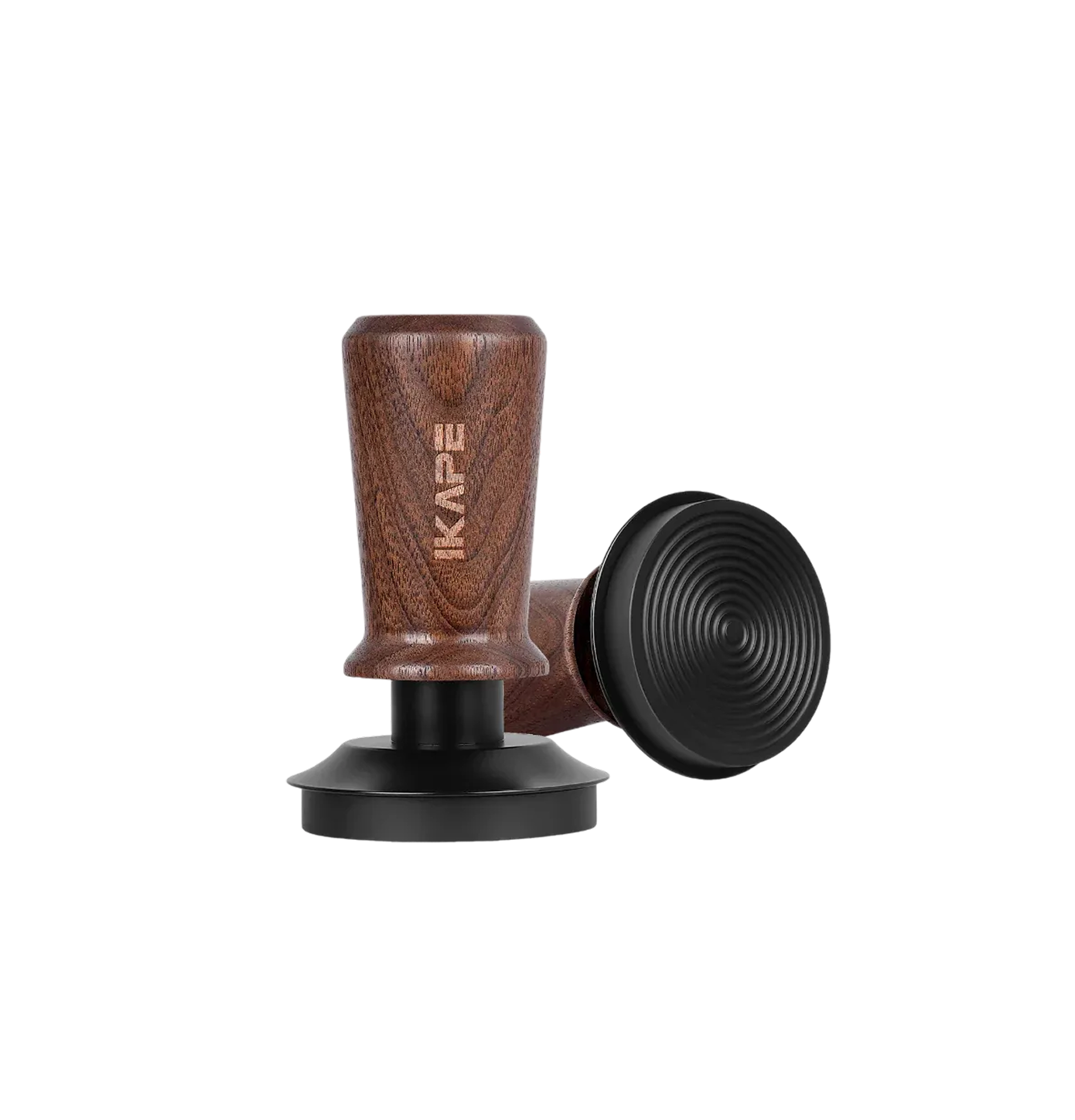
Lelit supplies professional 58 mm filters (IMS), a tamper, blind basket, scoop, softener filter, and a full barista-grade portafilter — allowing serious calibration from day one.
05
Real-World Performance of This Coffee & Espresso Machine with Grinder
Real-World Performance
Warm-Up, Thermal Behavior & Daily Rhythm
The daily experience of using the Lelit Kate PL82T is defined by rhythm — a rhythm shaped by the brass boiler's thermal inertia, the grinder's precision, and the LCC's informational clarity. The machine reaches operational readiness faster than classic E61 machines due to its smaller boiler, but it still benefits from a deliberate warm-up phase during which the brass achieves thermal equilibrium. This stability matters: when temperature fluctuates, the coffee puck extracts unevenly, causing shifts in acidity, bitterness, and texture. Once warmed, the Kate behaves predictably shot after shot, allowing the user to develop consistent habits. A brief flush brings the group to the ideal extraction zone, and the LCC display confirms system temperature, reinforcing user intuition with numerical feedback. The integration of grinder and machine also influences daily flow. With no need to reposition equipment or adjust multiple devices, the workflow becomes continuous — grind, distribute, tamp, extract — a cycle that encourages discipline. The solenoid valve ensures clean, dry pucks, reducing mess and enabling faster back-to-back preparation. Over days and weeks, users begin to "read" the machine: the sound of the pump, the feel of the portafilter, the behavior of the pressure gauge. This familiarity deepens technique and enhances consistency. The Kate is not designed for speed or automation; instead, it offers a daily ritual that builds skill and rewards attentiveness, giving beginners a structured foundation and experienced users a platform that respects their craft.
Back-to-Back Espressos: Consistency, Recovery & Grinder Response
When preparing multiple shots, the Kate PL82T performs with surprising consistency for a compact single-boiler system. The brass boiler retains heat well enough that consecutive extractions show minimal drift, and the LCC helps users anticipate small temperature changes that naturally occur as water flows through the system. Because thermal inertia is high relative to boiler size, recovery time is short and predictable. However, the grinder plays an even larger role in back-to-back reliability. Its stepless design allows minute corrections between shots, which is essential when dialing in for different coffees or compensating for environmental variables such as humidity. What distinguishes the Kate from consumer alternatives is the interaction between grinder stability and extraction stability. In many all-in-one machines, burr carriers flex under vibration, causing grind size to drift during repeated use. Here, the stainless-steel chassis absorbs that vibration, preserving burr alignment and maintaining particle size distribution. In practice, this means the second and third shots closely resemble the first, provided tamping and distribution are consistent. The solenoid valve further ensures the puck remains intact between attempts, preventing residual moisture from affecting successive extractions. For users preparing several espressos in a row — family mornings, small gatherings, tasting sessions — the Kate offers mechanical honesty: it does not hide flaws or automate corrections, but it maintains a steady enough platform that mistakes become visible, correctable, and educational. Over time, this fosters mastery rather than dependence on presets.
Milk Drinks: Steaming Capability, Control & Technique Development
Milk steaming on the Kate PL82T reflects Lelit's commitment to authenticity rather than convenience. The multidirectional wand and dry steam output allow users to apply proper barista technique — stretching, texturing, and integrating the milk into a cohesive microfoam. While the 300 ml boiler cannot compete with the instant power of heat-exchanger or dual-boiler machines, its steam remains consistent and predictable, which is in many ways more valuable for skill development. Beginners can learn to manage aeration without being overwhelmed by excessive pressure, and advanced users can practice replicating café-style textures on a smaller, more controlled scale. Because steaming and brewing cannot occur simultaneously, the workflow is sequential: pull the shot, switch to steam mode, texture the milk, then cool the boiler before the next extraction. Although slower than professional systems, this cadence teaches timing and understanding of thermal cycles. Importantly, the steam produced is "dry" — meaning it contains less water vapor than entry-level machines. This makes it easier to produce glossy, elastic microfoam suitable for latte art. The wand responds accurately to positioning and pitcher angle, helping users refine tactile and auditory cues. Over time, this encourages a deeper grasp of milk dynamics: how proteins stabilize foam, how temperature affects sweetness, how vortex formation leads to uniform texture. The Kate does not automate milk — it trains the user to master it.
Technical Feedback, Learning Curve & Skill Progression
One of the Kate PL82T's most valuable qualities is the transparency of its feedback. Unlike consumer appliances designed to hide mistakes through automation, the Kate reveals every variable: grind distribution, tamping accuracy, pressure stability, temperature behavior, and shot progression. The LCC display provides quantitative data — brew temperature, steam temperature, extraction time — while the pressure gauge offers qualitative, real-time insight into flow dynamics. The grinder, with its micrometric adjustment, immediately exposes whether a change was too coarse or too fine. Together, these elements form a feedback system comparable to that of stand-alone professional setups. This transparency accelerates learning. Beginners can diagnose extraction issues: fast shots indicate coarse grind or insufficient puck resistance; slow, uneven shots suggest channeling or overfine grinding. Intermediate users benefit from repeatability — matching time, pressure curves, and taste. Advanced users can push the machine by experimenting with dose, yield, and grind profiles. The machine does not compensate; it reflects. And this honesty is rare in integrated systems. The result is a tool that grows with the user. After weeks and months, technique sharpens: tamping becomes consistent, distribution more deliberate, and extraction more controlled. Rather than plateauing, the user continues to refine their craft, supported by a machine that rewards precision and punishes carelessness. It is this pedagogical quality that ultimately elevates the Kate beyond typical compact machines — it teaches espresso as a discipline.
06 Lelit Kate vs Other Espresso Machines with Grinder (Full Comparison)
Lelit Kate PL82T vs Lelit Anita (PL042TEMD)
The Lelit Anita PL042TEMD exists as Lelit's entry-level integrated system, designed for users seeking a first step into manual espresso with a built-in grinder. Its specification reflects this positioning: a 250 ml brass boiler, a TermoPID temperature controller, and 38 mm conical burrs with stepless micrometric regulation — solid components for a beginner-oriented platform. But Anita uses the LELIT57 group, which limits compatibility with the broader 58 mm ecosystem, and the build structure (10.2 kg, integrated tamper, simpler interface) makes it clear that its mission is ease and accessibility rather than long-term craft refinement. Its grinder, while respectable, sits inside a lighter chassis and does not benefit from the mechanical rigidity found in the Kate, which influences grind stability during vibration-heavy operation. Kate stands several tiers above Anita. Its 300 ml brass boiler provides superior thermal inertia, maintaining temperature consistency shot after shot. Its LELIT58 commercial group aligns it with the brand's professional-grade machines, enabling users to upgrade baskets, tampers, screens, and precision tools — a crucial difference for anyone serious about extraction. The integrated grinder benefits from a heavier stainless-steel frame that minimizes drift and ensures more reliable particle distribution over time. The LCC interface is significantly more advanced than Anita's TermoPID, offering expanded control over pre-infusion, standby behavior, wash cycles, and precise temperature readouts. In daily use, Kate feels more intentional, crafted for progression rather than merely accessibility. Anita is the "gateway"; Kate is the machine for those committed to mastering espresso as a craft rather than as a convenience.
Lelit Kate PL82T vs Lelit Victoria (PL91T)
The Victoria PL91T sits just above the Kate in Lelit's hierarchy — not because its thermal performance is superior (it shares the same 300 ml brass boiler, the same LCC platform, the same 3-way solenoid, and the same LELIT58 group) but because Victoria is designed as a machine-only solution meant to be paired with a high-grade external grinder. Its compact profile (23 cm wide, 11.3 kg) makes it an elegant, minimalist single-boiler system where the grinder becomes the real engine of performance. Users who pair Victoria with 64 mm flat burrs or large conical burr grinders can achieve clarity, uniformity, and extraction profiles that no integrated grinder can match physically. This positions Victoria as a modular platform — the heart of a customizable setup. The Kate, however, embodies a different philosophy: coherence. The machine and grinder are engineered to function as a unified ecosystem, ensuring low retention, direct dosing, predictable alignment, and daily workflow simplicity. While Victoria may outperform the Kate when matched with a premium grinder, it also demands more space, a larger budget, and a deeper willingness to manage multiple variables. Kate offers the opposite strength: precision in a compact format, where grinder and boiler operate in organic harmony. Victoria is the machine for users who want ultimate control through modular upgrades; Kate is the machine for users who want disciplined, compact mastery without compromising build quality or mechanical seriousness.
Lelit Kate PL82T vs Lelit Mara X
The Mara X is Lelit's most celebrated E61 heat-exchanger machine, delivering near–café-level thermal performance in a compact residential format. Compared to the Kate, the Mara X has a dramatically different architecture: a large HX boiler with PID-managed thermosiphon modulation, allowing it to maintain stable brew temperatures while also providing high steam power. It supports simultaneous brewing and steaming — something the Kate's single boiler cannot offer. For users who frequently prepare milk drinks or want the richness that E61 groups bring through thermal mass and natural pre-infusion, the Mara X can achieve results beyond any integrated grinder machine. But the Mara X requires a dedicated grinder, meaning the total footprint becomes significantly larger. It also demands a deeper understanding of flushing routines, heat saturation, and boiler management. The Kate instead proposes a compact, tightly engineered system that teaches the fundamentals of espresso extraction with clarity and minimal friction. The workflow is simpler, the warm-up faster, and the footprint much smaller. Ultimately, Mara X embodies the path toward professional-level performance, whereas the Kate embodies the path toward disciplined, space-efficient mastery. They serve different user identities: Mara X for high-performance enthusiasts; Kate for space-constrained baristas seeking serious craftsmanship.
Lelit Kate PL82T vs Sage/Breville Barista Express
The Barista Express is the best-selling all-in-one espresso machine globally — but it belongs to a fundamentally different category. Designed for convenience and accessibility, it uses a thermocoil heating system that warms quickly but lacks the temperature stability of the Kate's 300 ml brass boiler. Under repeated use, thermocoils fluctuate significantly, leading to variability in shot temperature and flavor. The Express's grinder, while user-friendly, uses smaller burrs with stepped adjustment, sharply limiting the machine's ability to dial in espresso at a specialty level. The Kate approaches espresso as a craft rather than a convenience product. Its stainless-steel chassis, larger brass boiler, 3-way solenoid valve, and commercial-standard 58 mm group create conditions for genuine espresso extraction — something the Barista Express can approximate but not truly replicate. The grinder on the Kate is stepless, giving fine control; the Express offers fixed jumps between settings. The internal build quality also differs: the Kate is engineered for durability and serviceability, while the Express relies heavily on plastic and integrated electronics that tend to degrade faster. For beginners wanting push-button ease, the Express is appealing. For users who want to progress, understand extraction, and drink espresso that reflects their technique, the Kate exists in an entirely different league.
Lelit Kate PL82T vs DeLonghi La Specialista / Specialista Opera
The Delonghi Specialista line markets itself as a premium hybrid between manual espresso and automation, but internally it is far closer to a consumer appliance than a specialty-grade machine. Its dual thermoblock design offers speed but limited thermal stability, and its grinder architecture — with angled burrs and high retention chambers — is not optimized for true espresso precision. The automated tamping system eliminates user error but also eliminates user control, preventing mastery of puck preparation, which is foundational to real espresso craft. The Kate PL82T is engineered from the opposite perspective: manual skill supported by professional-grade mechanical components. Its brass boiler delivers more stable heat, its grinder provides genuine stepless adjustment, and its 3-way solenoid ensures clean, professional extraction endings. The Specialista produces coffee drinks that look like espresso drinks, but the Kate produces espresso that behaves like espresso — dense, viscous, expressive, and sensitive to technique. In long-term durability, the Kate's stainless-steel construction and serviceable internal layout outperform the Specialista's plastic-heavy frame and electronics-heavy design. One machine prioritizes lifestyle convenience; the other prioritizes extraction quality, longevity, and craft. For users serious about real espresso, the Kate is the clear choice.
Lelit Kate PL82T vs Other Integrated Appliances
Most integrated espresso appliances — especially in the mid-range segment — prioritize convenience, programmability, and automation. They often lack thermal mass, rely on small burrs with limited precision, and use pressurized baskets to mask grind inconsistencies. While these machines offer stability in ease of use, they impose a strict ceiling on espresso quality. Users quickly hit the limit of what the machine can express, especially when experimenting with lighter roasts or more demanding extraction ratios. The Kate PL82T is one of the few integrated systems built on professional espresso fundamentals: a true brass boiler, a real 3-way solenoid valve, a stainless-steel chassis, a commercial-standard 58 mm group, and a stepless micrometric grinder. This combination makes it uniquely capable of producing specialty-level espresso in a compact, all-in-one body. It does not hide extraction variables; it exposes them. It does not automate technique; it rewards it. This makes the Kate stand apart: it is not an appliance, but a machine — one that behaves far more like a modular espresso setup than its footprint suggests. For users seeking authenticity without the space requirements of a two-unit setup, the Kate is unmatched.
Lelit Kate PL82T vs Dedicated Machine + Separate Grinder
A separate high-end espresso machine paired with a standalone grinder is the traditional gold standard for home baristas. Larger burr sets (54–83 mm), greater thermal capacity (HX or dual boiler systems), and modular upgrade paths enable performance levels no integrated system can match. However, this approach requires more counter space, a larger budget, more maintenance, and a more complex workflow. It is the right choice for users fully committed to espresso craft and ready to invest deeply. The Kate PL82T exists to serve those who seek craft-level control without committing to a full ecosystem. Because its grinder sits directly above the portafilter, retention is low and dosing is consistent. Because its boiler and grinder are engineered together, the machine responds predictably to grind adjustments and extraction variables. This coherence means that many home baristas produce better everyday espresso with the Kate than with mismatched machine-grinder setups that are theoretically superior but practically inefficient. The tradeoff is upgradeability: with the Kate, the grinder cannot be replaced independently. With a modular system, users can evolve continuously. But for most people — especially those constrained by space or seeking daily reliability — the Kate offers an optimal blend of precision, compactness, and repeatability that very few setups achieve. It is not the maximalist's tool, but the minimalist's high-performance instrument.
07 Pros of the Lelit Kate as a High-End Espresso Machine with Grinder
minimal footprint
adjustment precision
extractions
daily consistency
ecosystem
construction
small kitchens
08 Cons & Structural Limits of an Integrated Coffee & Espresso Machine with Grinder
alternate brew/steam
pro-level machines
control
upgrade flexibility
optimize performance
09 Should You Buy the Lelit Kate PL82T as Your Espresso Machine with Grinder?
The Lelit Kate PL82T is not a machine designed to please everyone. It is built for a specific type of person — someone who values discipline over automation, coherence over modular sprawl, and mechanical stability over convenience features. If you are looking for a push-button appliance that produces predictable results without demanding your attention, the Kate is not the right fit. It exposes grind quality, tamping accuracy, distribution, and temperature awareness. It presents espresso not as a shortcut but as a process: one that rewards intention and reveals inconsistency. And for many users, this is precisely where its value lies.
If you are entering espresso with the desire to understand extraction, not just consume it, the Kate becomes a powerful companion. Its integrated grinder eliminates the most common beginner mismatch — pairing a weak grinder with a capable machine — and instead creates a unified tool where every adjustment is visible in the cup. The brass boiler provides thermal steadiness; the LELIT58 group opens the door to professional accessories; the LCC gives numerical clarity; the solenoid ensures clean, decisive extractions. Together, these elements form a compact platform for long-term progression.
The Kate is ideal for users with limited counter space who refuse to compromise on espresso craft. It suits those who want to refine their workflow, pull consistent shots, and upgrade their skills without expanding their kitchen into a miniature café. It is also well suited to intermediate baristas who understand the limitations of consumer appliances and want a machine that behaves seriously without demanding the footprint of a separate machine and grinder.
However, if you plan on experimenting with ultra-light roasts, expect simultaneous brewing and steaming, or prefer a setup that will later evolve into an E61 or dual-boiler system, a modular machine-plus-grinder configuration (or a machine like the Mara X) will eventually serve you better. The Kate is a destination, not a stepping stone — a compact, coherent machine intended to stay with you for many years.
In essence, choose the Lelit Kate PL82T if you want a disciplined, mechanically honest espresso setup that teaches you more each week than the week before. It is not a machine that hides your technique. It is one that elevates it.
10 Full Technical Specifications of the Lelit Kate PL82T Espresso Machine
11 Lelit Kate FAQ: Espresso Machine with Grinder, Coffee Machine with Built-In Grinder & Lelit Brand Questions
Is the Lelit Kate a real espresso machine or just a coffee machine with grinder?
The Lelit Kate is a true espresso machine with grinder, not a generic coffee machine with built-in grinder. It uses a real 58 mm commercial portafilter, a vibratory espresso pump, a 300 ml brass boiler managed by the Lelit Control Center (LCC), and a three-way solenoid valve. It follows professional espresso standards, not appliance-grade shortcuts.
Is an espresso machine with integrated grinder better than a separate grinder setup?
An espresso machine with grinder offers perfect grind-to-brew alignment, compact footprint, and simpler workflow. A separate grinder setup offers higher upgrade potential and larger burr options. The Lelit Kate sits between both worlds: integrated precision with prosumer-level performance.
Is the Lelit Kate better than the Barista Express?
Yes, mechanically and in extraction consistency. The Lelit Kate uses a brass boiler with stable temperature management via the LCC and a stepless grinder. The Barista Express relies on a thermocoil system, more plastic components, and stepped grind adjustment, which limits fine espresso calibration.
Is the Lelit Kate better than the Delonghi Specialista?
For real espresso control, yes. The Specialista prioritizes sensors, presets, and automation. The Lelit Kate prioritizes manual control, mechanical stability, and extraction transparency. One is convenience-focused, the other is craft-focused.
Is the Lelit Kate suitable for beginners?
Yes, for serious beginners who want to learn real espresso fundamentals: grind size, dose, tamping, extraction time, temperature behavior, and milk texturing. It is not designed for users who want push-button automation.
Is the Lelit Kate good for advanced home baristas?
Yes, within the limits of an integrated machine. It provides stable pressure, precise grinding, and predictable thermal behavior via the LCC. Advanced users looking for E61 thermal mass or 64–83 mm burrs may eventually move to modular systems.
Can the integrated grinder be replaced later?
No. The grinder is structurally integrated into the machine. If you require long-term grinder modularity, a separate grinder setup is more appropriate.
Does the Lelit Kate grind fine enough for true espresso?
Yes. The stepless conical burr grinder produces true espresso-grade particle sizes suitable for both traditional and modern espresso extraction profiles.
Is the grinder on the Lelit Kate better than typical built-in grinders?
Yes. Most built-in grinders use small stepped burrs with inconsistent calibration. The Kate uses stepless conical burrs with real micro-adjustment, closer to standalone grinders.
Is the Lelit Kate good for light roast espresso?
Yes. Thanks to stable brass boiler behavior and fine grind calibration, the Kate handles light to medium roasts far better than thermoblock machines or appliances with pressurized baskets.
Can you brew and steam at the same time on the Lelit Kate?
No. The Kate uses a single-boiler architecture. Brewing and steaming are sequential, not simultaneous. This is the main structural limitation of the machine.
Is the steaming power sufficient for latte art?
Yes. The steam wand produces dry, controlled steam suitable for real microfoam and latte art, provided the user manages boiler transitions correctly.
Is the Lelit Kate better than Lelit Anita?
Yes. The Kate offers a larger brass boiler, advanced LCC control, a 58 mm group, better thermal stability, and a higher-grade integrated grinder.
Is the Lelit Kate better than Lelit Victoria?
The Victoria can outperform the Kate when paired with a high-end external grinder. The Kate offers a more compact all-in-one workflow with integrated precision.
Is the Lelit Kate a prosumer espresso machine?
Yes. It sits at the entry level of the prosumer category: real brass boiler, real integrated grinder, real pressure behavior, and professional 58 mm group architecture.
Where are Lelit espresso machines made?
Lelit machines are designed and manufactured in Italy. The brand focuses on mechanical espresso engineering rather than mass-market appliances.
How long does the Lelit Kate take to heat up?
Approximately 10–15 minutes for full boiler and group thermal equilibrium.
How often should I descale the Lelit Kate?
Every 2–3 months depending on water hardness. Using filtered or low-mineral water significantly extends descaling intervals.
Does the Lelit Kate require backflushing?
Yes. The three-way solenoid valve allows proper detergent backflushing for group head maintenance.
Is the Lelit Kate noisy?
Noise level is typical of vibratory pump espresso machines and integrated grinders. It is quieter than many consumer machines but louder than rotary-pump systems.
Does the Lelit Kate use pressurized baskets?
It can, but it is fundamentally designed for non-pressurized baskets and real espresso grinding.
What type of coffee is best for the Lelit Kate?
Fresh-roasted espresso beans between light-medium and medium-dark perform best. Very dark supermarket coffee limits extraction potential regardless of machine quality.
Can the Lelit Kate make café-quality espresso?
Yes. With proper beans, grind calibration, and technique, the Kate is fully capable of café-level espresso quality.
Is the Lelit Kate good for daily use?
Yes. It is built for daily home use with durable stainless-steel chassis, serviceable internal components, and stable operating behavior.
How long does the grinder last on the Lelit Kate?
With proper cleaning and light usage, the integrated burrs typically last several years in home environments.
Is the Lelit Kate good for small kitchens?
Yes. Its main strategic advantage is that it replaces a two-machine setup with a single compact footprint.
Is the Lelit Kate better than a fully automatic espresso machine?
Yes for coffee quality and control. Fully automatic machines prioritize convenience and speed over extraction purity and grind calibration.
Is the Lelit Kate good for cappuccino and milk drinks?
Yes. It produces proper microfoam and stable espresso for milk-based drinks, provided users manage the single-boiler workflow correctly.
Can the Lelit Kate make two drinks in a row easily?
Yes. It handles back-to-back espresso shots well. Milk drinks require boiler mode switching between brewing and steaming.
Is the Lelit Kate good for offices?
It can serve small offices or light professional use but is fundamentally a high-end home espresso machine.
Does the Lelit Kate support bottomless portafilters?
Yes, as it uses a standard 58 mm group.
Is the Lelit Kate easy to repair?
Yes. Lelit machines are known for mechanical accessibility and parts availability compared to sealed consumer appliances.
Is the Lelit Kate overpriced?
No. It realistically replaces a mid-range grinder and a mid-range espresso machine, making its total cost competitive.
Who should NOT buy the Lelit Kate?
Users who want: one-touch brewing, zero grind adjustment, simultaneous brewing + steaming, or no learning curve. Those users should choose automatic machines instead.
Who should definitely buy the Lelit Kate?
Users who want: real espresso mechanics, grind-to-cup calibration, manual control, compact prosumer performance, and long-term skill progression.
10/10


Grinder
Precision
10/10
Thermal
Stability
10/10
Build Quality
& Durability
10/10
Workflow
Integration
{{for-who-title-right}}
Find where to buy Lelit Kate PL82T
Apply to become a reseller


Lelit Kate PL82T Manufacturer
Lelit is an Italian manufacturer specializing in prosumer espresso machines that blend traditional mechanical espresso engineering with modern control systems. Founded with a focus on compact, serviceable, and thermally stable machines, Lelit builds tools for home baristas who seek café-quality extraction without commercial-scale infrastructure. Their design philosophy emphasizes brass boilers, PID temperature control, modular 58 mm groups, and mechanical transparency — creating machines that teach technique rather than automate it away.