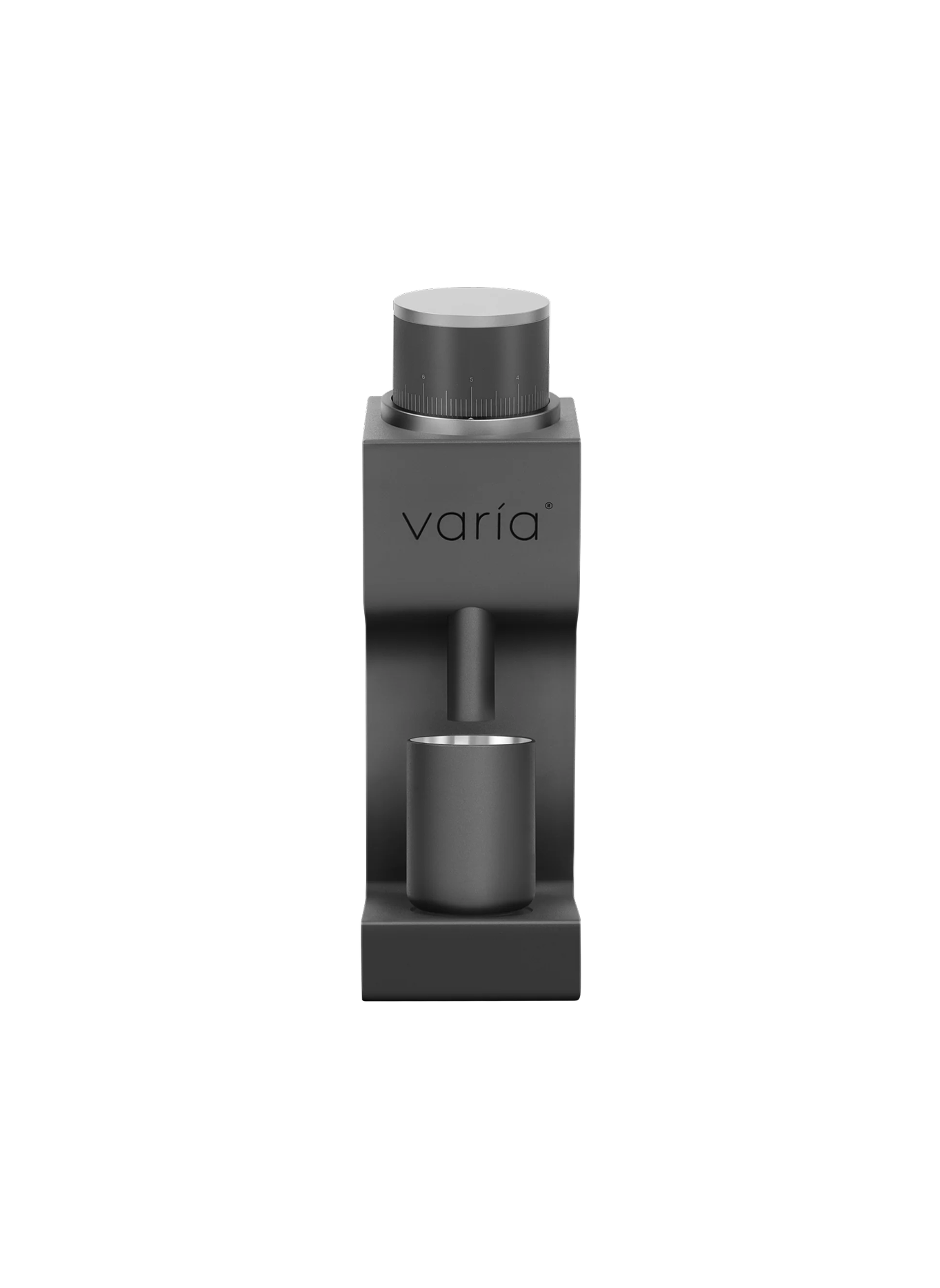
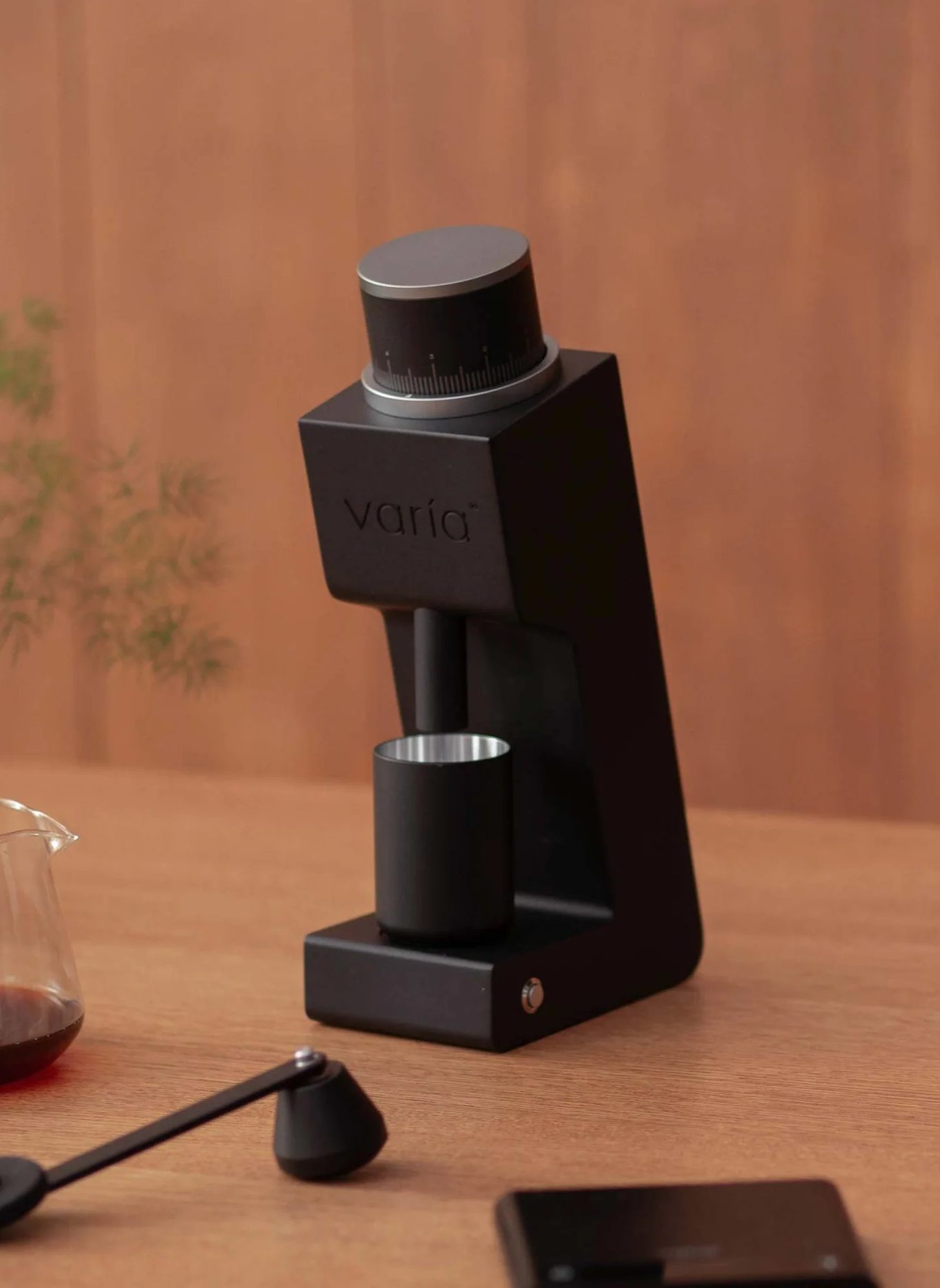
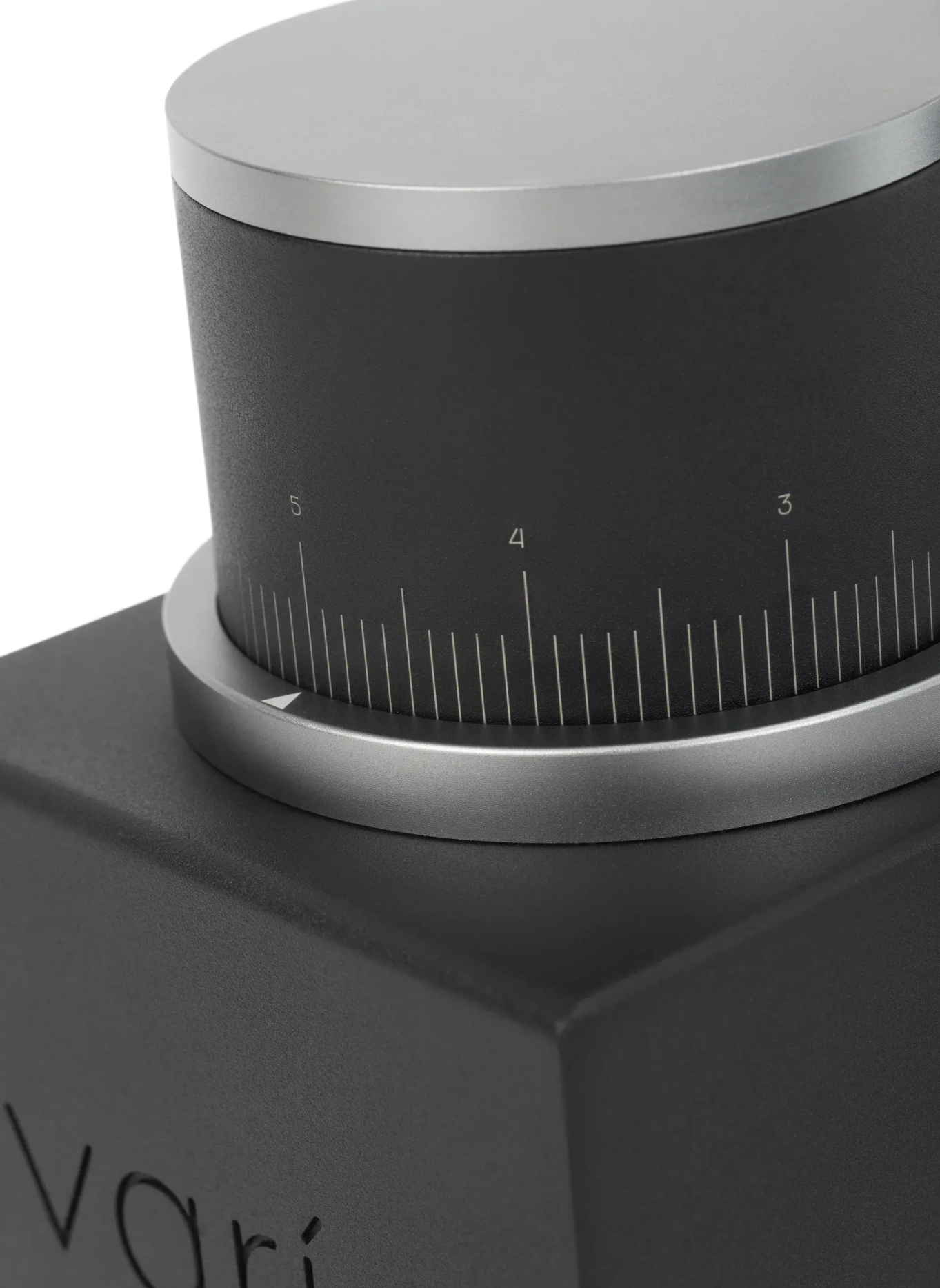
Varia VS3 Review The Best Budget Single-Dose Espresso Coffee Grinder? Coffee Grinder by Varia

Start at $289
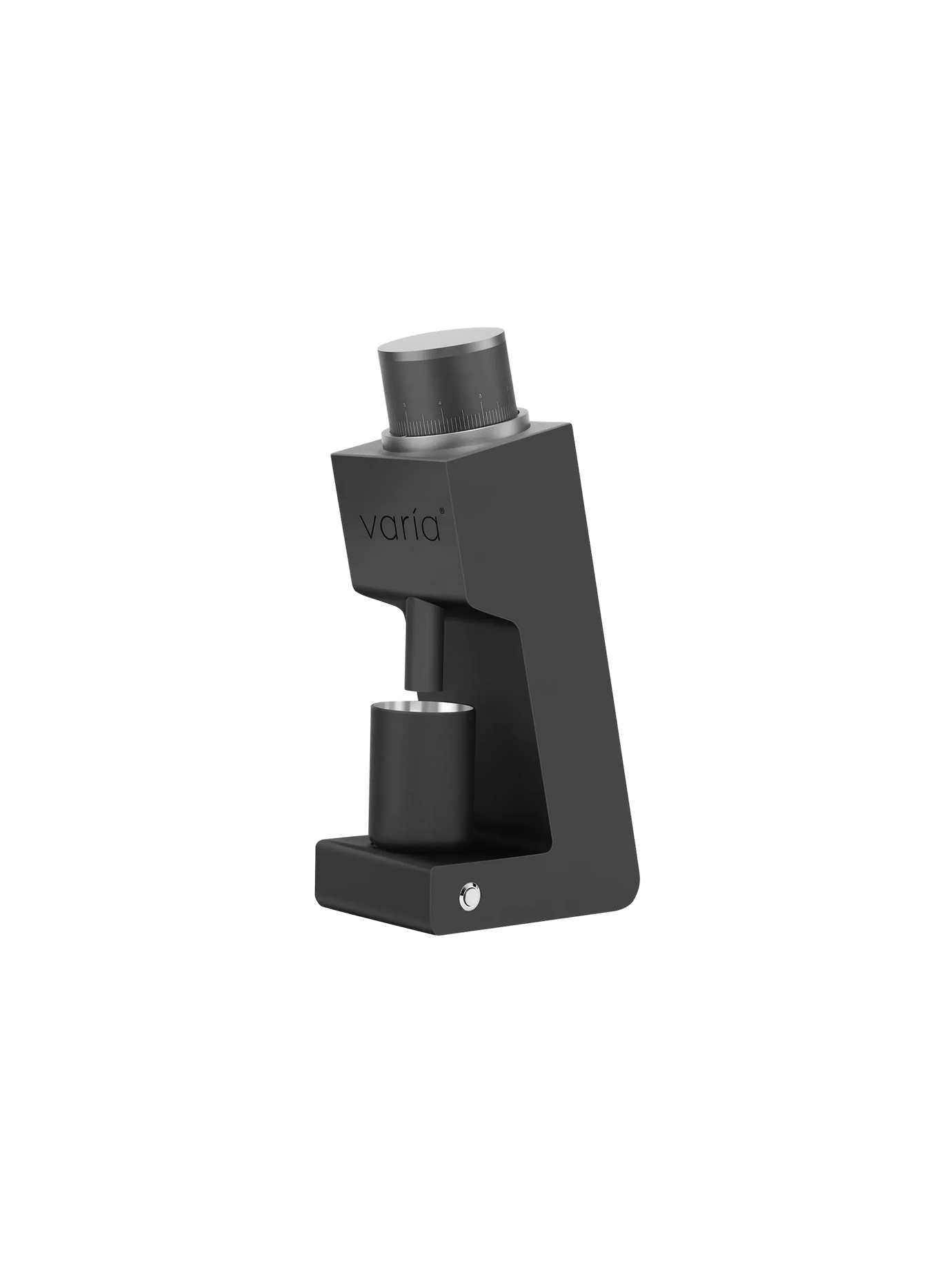
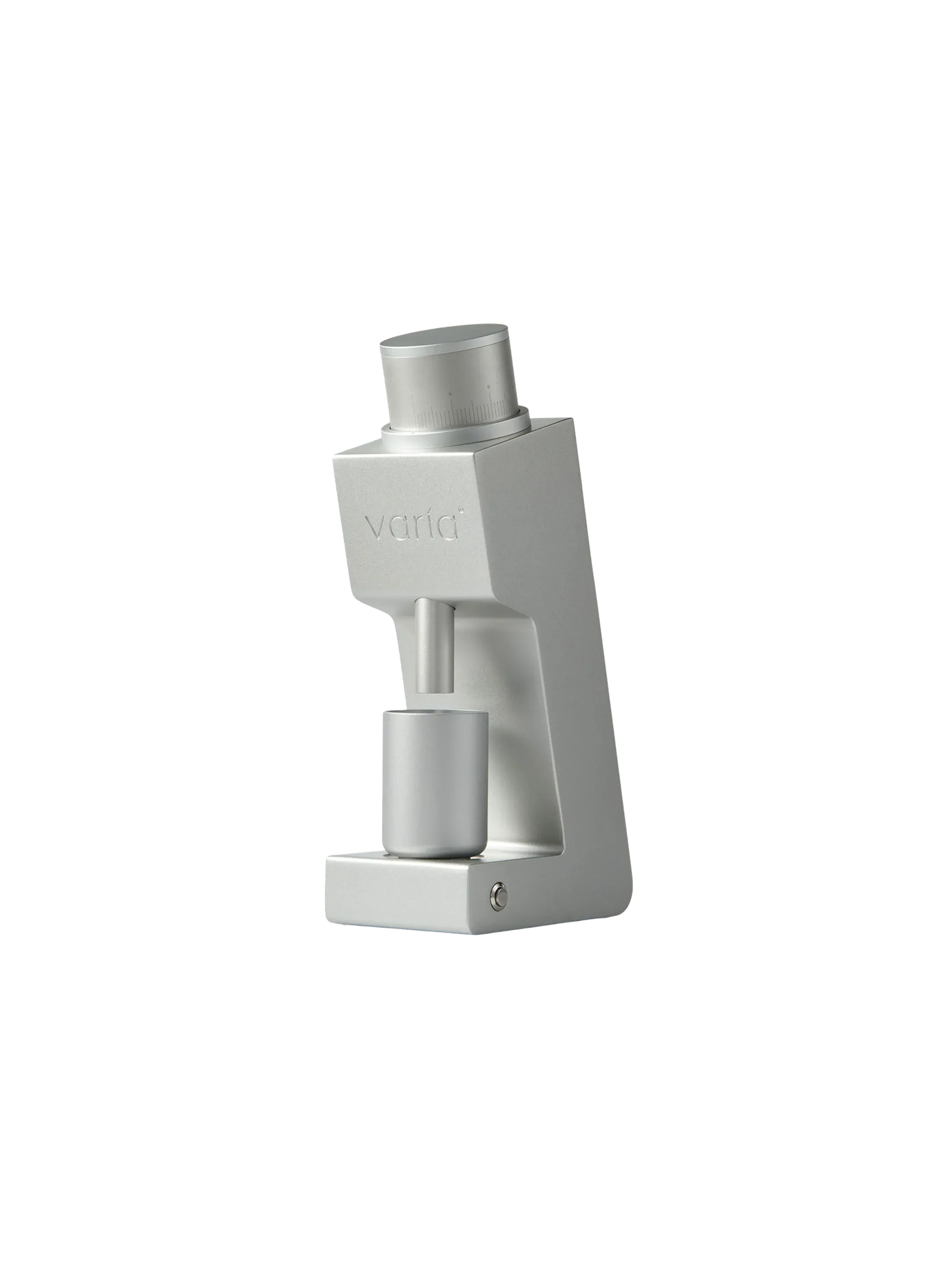
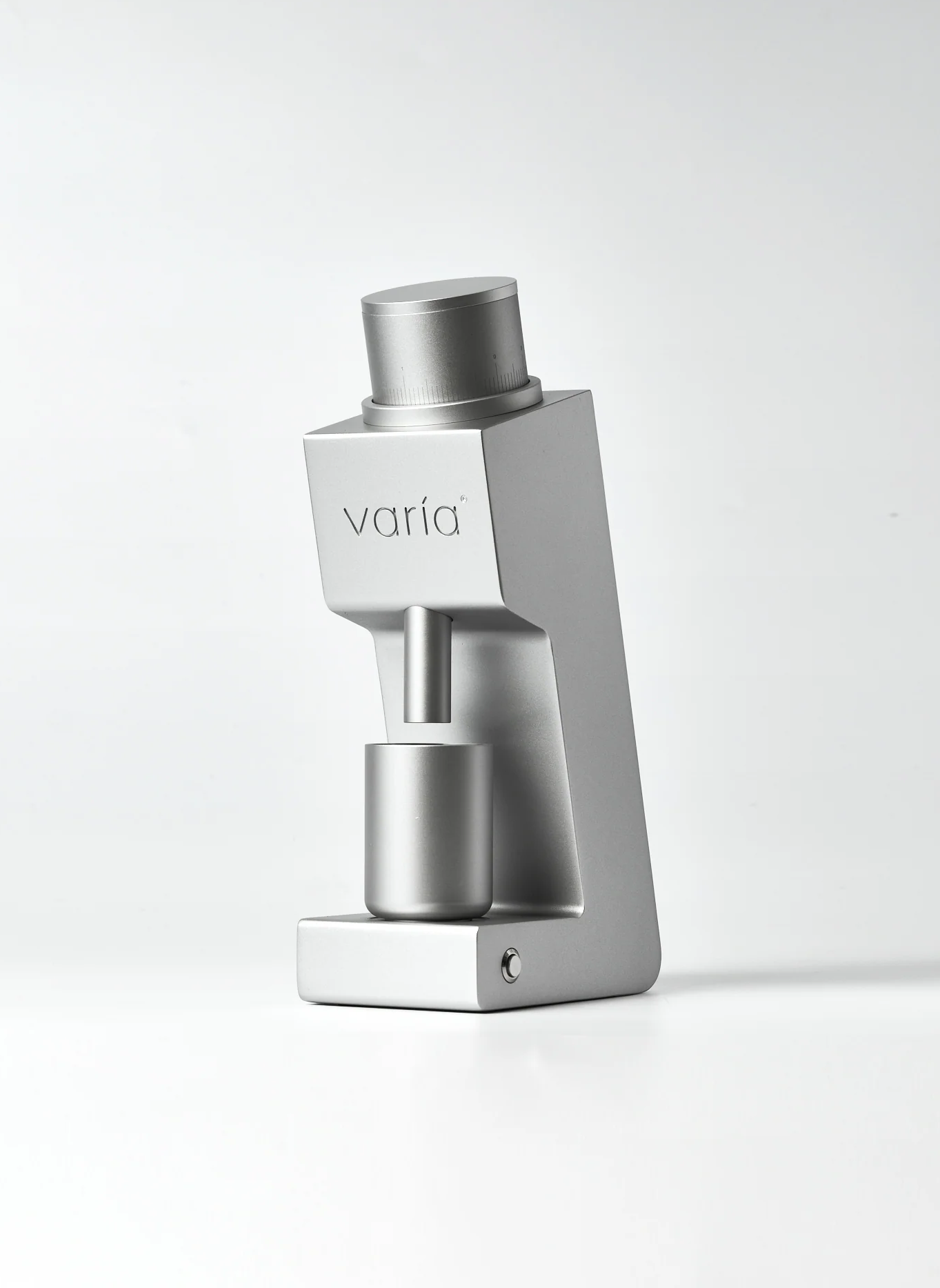
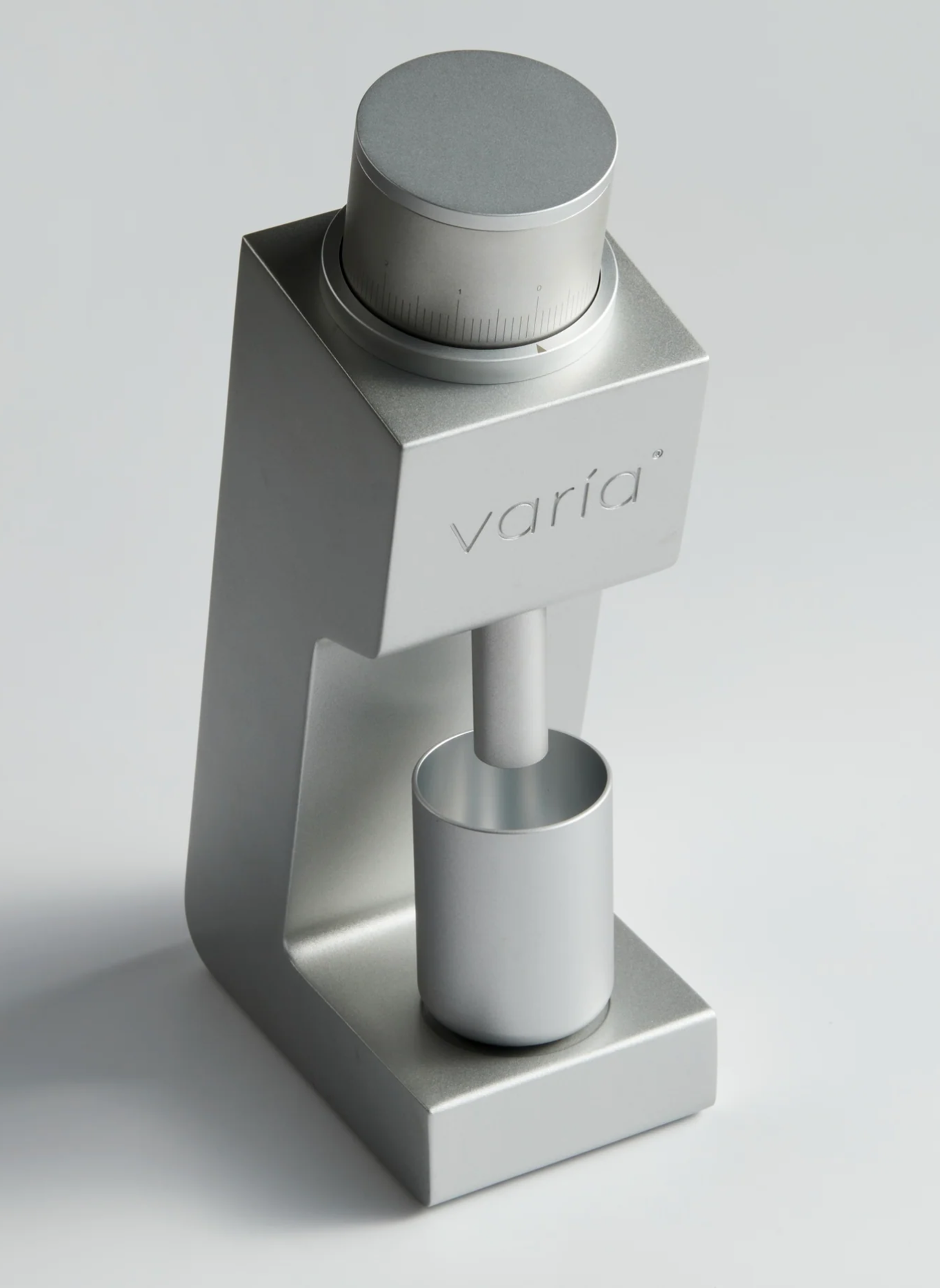
The Varia VS3 is a compact, precision-engineered single-dose grinder built around a 48 mm stainless-steel conical burr set, a low-RPM DC motor, and a fully metal chassis for stability and repeatability. Designed for espresso and filter brewing alike, it combines tight tolerances, minimal retention, and stepless 10-micron grind adjustment to deliver controlled, predictable particle geometry for demanding home baristas.
01 The Core Strengths
of the Varia VS3
-
48 mm conical burrs for consistent particle geometry
-
Stepless 10-micron vertical adjustment
-
Extremely low retention design
-
Rigid ADC12 aluminum body for stability
-
Low-RPM DC motor with stainless-steel gearbox
Quick Varia VS3 Highlights
-
Type
Single-dose electric grinder
-
BUILD MATERIALS
Full metal · ADC12 aluminum
-
TARGET USERS
Advanced home baristas
-
SKILL LEVEL
Intermediate to Advanced
-
WORKFLOW
Manual · Dialing-focused
-
RETENTION
Extremely low
-
CAPACITY
30 g hopper
-
GRIND SYSTEM
48 mm conical burrs
02
TL ; DR Quick Summary — the Varia VS3
in One View
The Varia VS3 is a single-dose precision grinder built for users who want granular control of grind size with minimal retention, high mechanical stability, and quiet, low-RPM performance. Its 48 mm conical burrs, stepless adjustment, and controlled grind speed form a platform that prioritizes consistency over automation. Nothing here disguises the grind: the VS3 exposes your technique, rewards small corrections, and lets you taste every variable you choose to control. In one sentence, this grinder is a compact, metal-built instrument for high-accuracy espresso and filter dialing.
03 Why the Varia VS3 Matters for Espresso Our review.
Grinders define the ceiling of what your espresso machine can achieve. A stable grind distribution, predictable adjustments, and minimal retention matter far more than sheer power. Many consumer grinders compensate for instability with fast burr speeds, plastic housings, or stepped adjustment systems that restrict precision. They appear convenient, yet they flatten the potential of your beans.
The Varia VS3 takes the opposite approach. Its 48 mm conical burrs, cut from high-nitrogen 420 stainless steel, operate at a controlled 170-RPM load speed to reduce heat, preserve aromatics, and stabilize particle formation. This slow, deliberate mechanical behavior gives the VS3 a clarity-first grind signature that reveals sweetness and body in espresso while keeping filter brews open and expressive. The stepless 10-micron vertical adjustment is not a gimmick — it offers fine control without the jumpiness of lightweight carriers. Each adjustment is repeatable, and small increments translate directly into extraction behavior.
The die-cast ADC12 aluminum chassis contributes to more than aesthetics. It suppresses vibration, maintains burr alignment, and gives the motor/gearbox assembly a stable frame that does not flex during load. Combined with a stainless-steel gearbox and a DC motor designed for torque rather than speed, the grinder behaves predictably under resistance — the hallmark of a serious single-dose tool. Retention remains extremely low (sub-0.1 g with RDT), making workflow clean and dose-accurate without purging grams between shots.
In daily use, the VS3 feels honest. A small shift in your workflow — bean age, humidity, RDT technique — becomes visible in the cup. For espresso, grind adjustments have a direct, measurable relationship to flow time and flavor. For filter, the grinder highlights clarity without muting structure. This mechanical transparency is rare in compact grinders and a defining strength of the VS3.
Nothing here is hidden. No automation smooths over technique. But when your distribution, dose, and grind are aligned, the VS3 produces shots and brews that feel far above its size — clean, repeatable, and texturally coherent. It is, in essence, a compact study in restraint: fewer parts, more discipline, better coffee.
04
The Varia VS3 From the Inside Out
Features & Benefits
Before looking at each component, the VS3 should be understood as a compact mechanical system optimized for alignment, torque control, and low retention. Its architecture is not built around high-speed grinding or volumetric throughput, but rather around the physics that create stable, predictable particle geometry. Slow RPM, rigid construction, and tightly controlled burr positioning allow the grinder to operate in a zone where heat, vibration, and mechanical drift remain minimal. This matters because coffee responds extraordinarily to small changes in temperature and pressure: when burrs heat up, oils behave differently; when alignment shifts, distribution tails become uneven; when torque fluctuates, the particle curve becomes less stable. The VS3 avoids these instabilities by prioritizing mechanical discipline. Every component — from the die-cast chassis to the stainless-steel gearbox — either stabilizes energy, transfers torque cleanly, or preserves burr alignment. The result is a grinder that behaves less like a consumer appliance and more like a compact precision instrument: consistent under load, transparent in adjustment, and capable of translating user intent directly into cup quality.
48 MM Conical Stainless-Steel Burrs (HRC58)
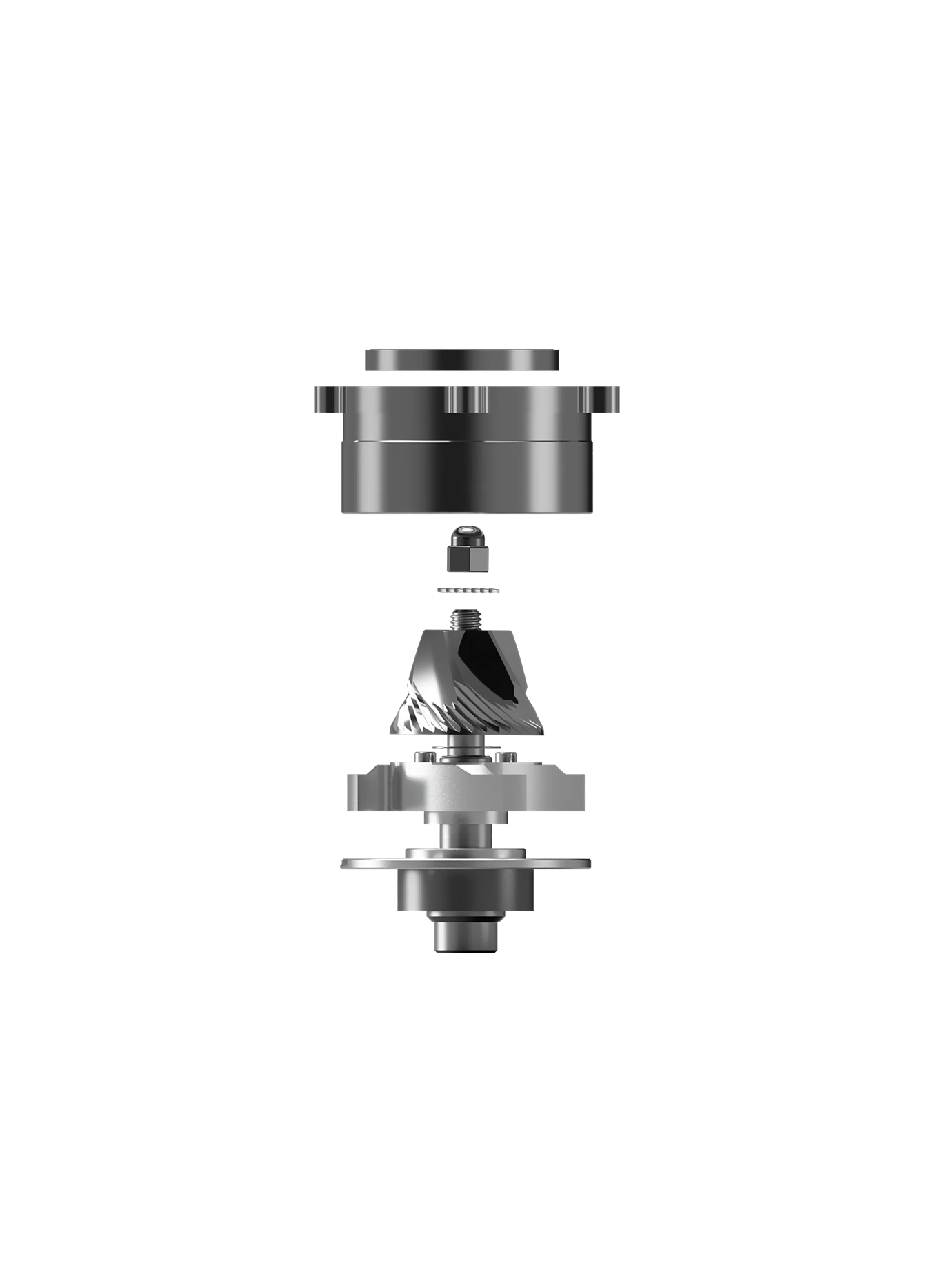
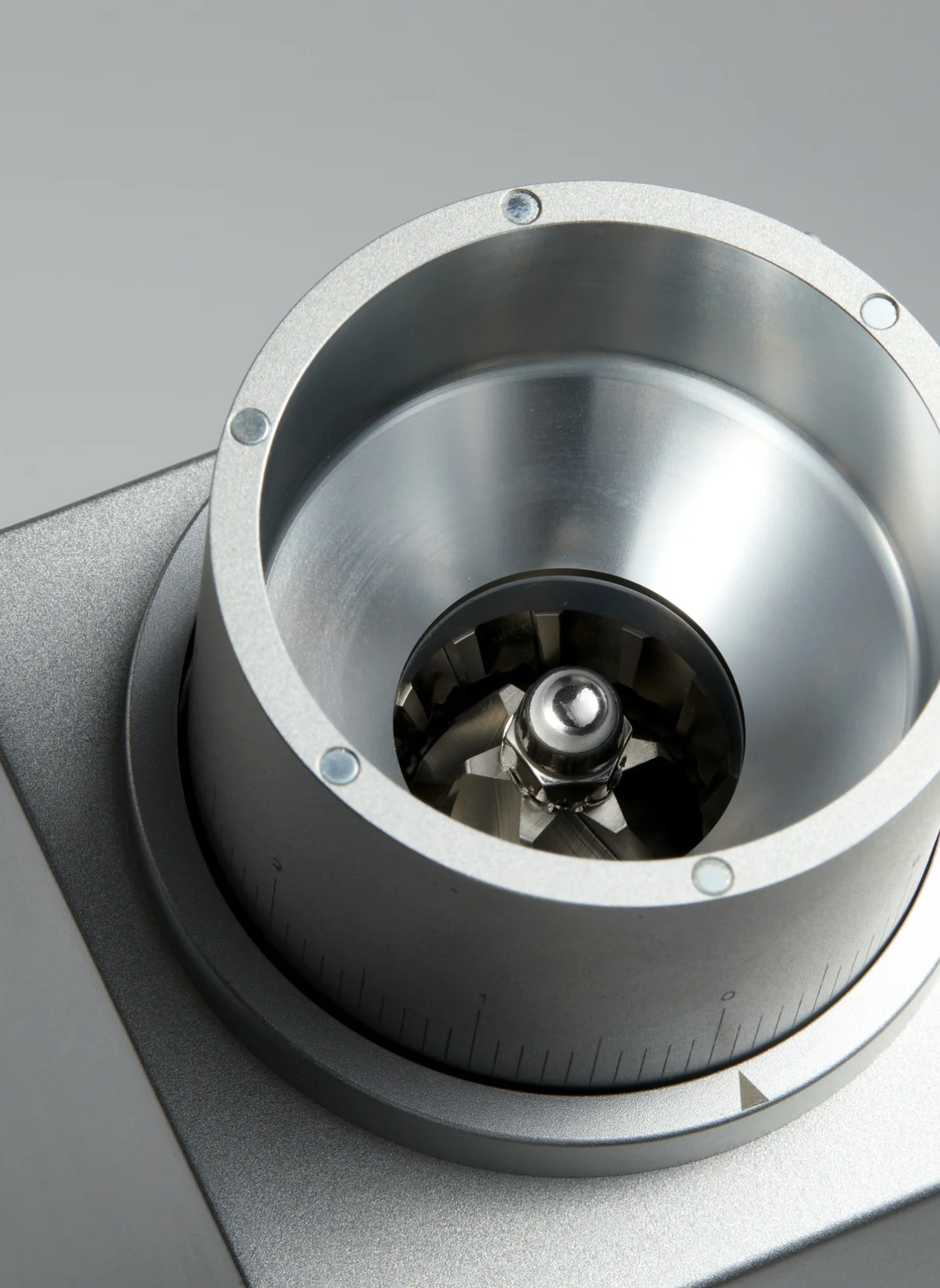
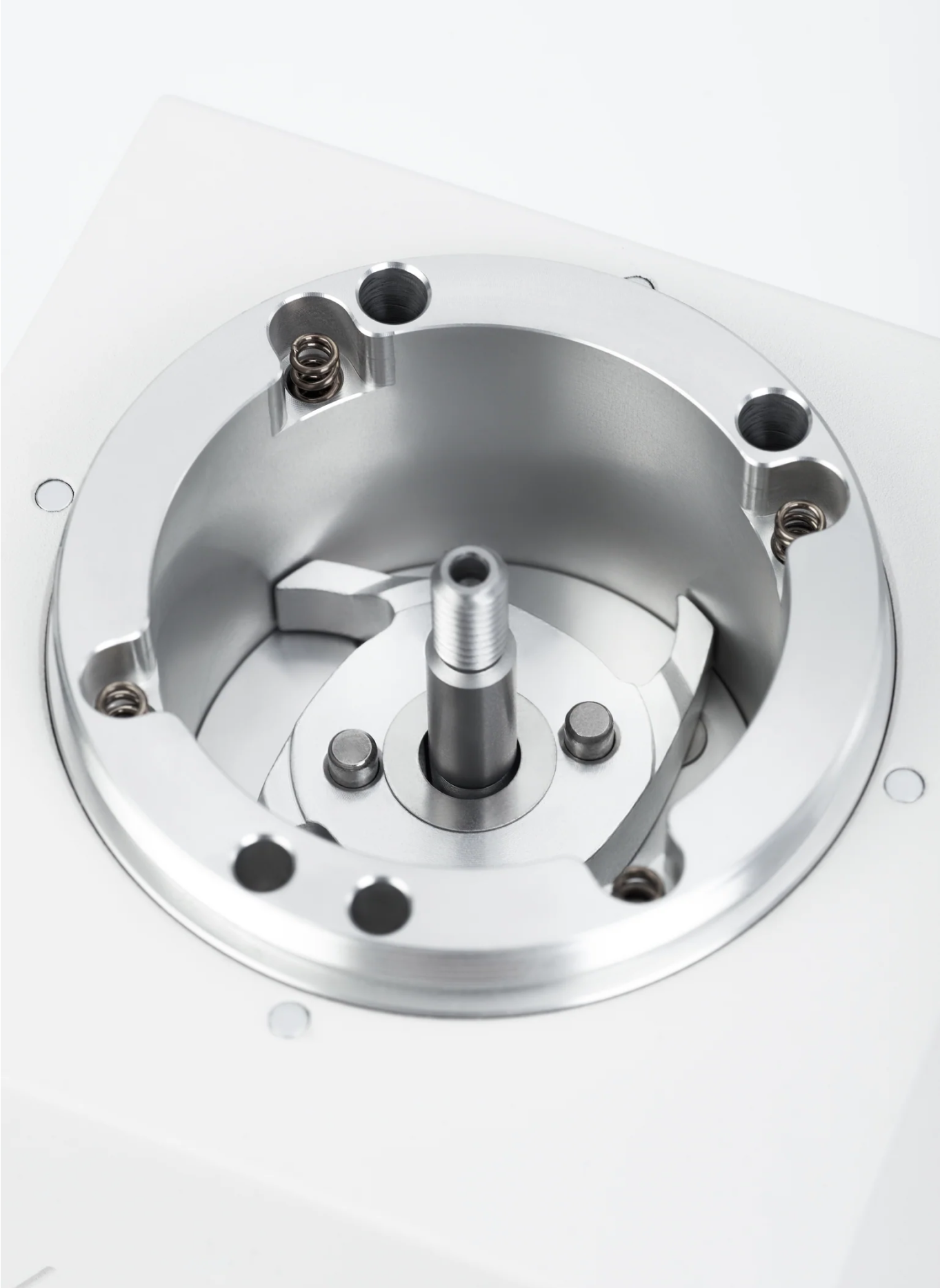
These 48 mm, 6-core conical burrs made from high-nitrogen 420 stainless steel (hardened to HRC58) embody the central philosophy of the VS3. Conical geometry naturally guides beans downward, reducing the likelihood of popcorning or irregular feed behavior — both of which can undermine particle uniformity. The material itself is engineered for longevity and edge retention: at HRC58, the cutting surfaces maintain sharpness over roughly 150 kg of use, ensuring that the grinder performs consistently for years rather than months. Operating these burrs at low RPM reduces heat buildup, preserving the aromatic oils and volatile compounds that define sweetness, fruit notes, and clarity. This matters especially for light roasts, which are sensitive to temperature spikes and can easily taste muted if ground too hot. By keeping the energy transfer slow and controlled, the VS3 allows the burrs to "shape" the grind rather than shred beans at high speed, resulting in an extraction curve that feels cleaner, more articulate, and more balanced. For the user, this means espresso with enhanced structure and filter brews with more transparency.
Stepless 10-Micron Vertical Adjustment
A 10-micron vertical shift mechanism is not only a measure of precision — it directly influences how espresso behaves in the cup. When an adjustment system can move the burrs in extremely fine increments, the user gains the ability to manipulate water flow with surgical accuracy. Whether you are trying to extract a light Ethiopian evenly or tighten up a shot that flows slightly fast, a 10-micron step can create a meaningful difference in taste and texture. Because the VS3's adjustment is vertical, alignment is preserved during movement: the burrs do not tilt or yaw, which is common in cheaper systems where adjustment mechanisms introduce lateral stress. Vertical displacement means geometry remains centered, reducing the risk of uneven particle distribution. For the user, the benefit is predictability: when you change the setting, the resulting extraction behaves the same way every day. No guesswork, no compensation — just a clean, repeatable link between grind size and cup behavior, essential for anyone practicing serious espresso craft.
Low-Retention Single-Dose Path
Low retention is more than convenience; it is a fundamental requirement for accuracy. With measured retention below 0.1 g using RDT (0.2 g without), the VS3 ensures that every dose entering the burrs exits into the cup. This matters because stale grounds — even fractions of a gram — alter flavor, especially with lighter roasts where clarity and aromatic fidelity are fragile. The VS3 achieves this through a combination of geometry (short feed path), tolerances (tight burr chamber), and user-supported workflow tools such as the silicone bellows. For single-dosing, this design eliminates compounding errors: if you need a 15 g dose, you truly get 15 g, without leftover grounds influencing your next shot. It also enables rapid iteration: dial a shot, taste, adjust, and grind again without purging waste. For home baristas who value consistency and cleanliness, low retention is one of the clearest signs of a well-engineered grinder.
170-RPM DC Motor with Full Stainless-Steel Gearbox
The VS3's 100 W DC motor operates at a controlled 170 RPM under load — a deliberate decision that shapes the grinder's entire character. High-RPM grinders generate friction, which increases temperature, accelerates oxidation, and destabilizes extraction. Low RPM, by contrast, maximizes flavor clarity by minimizing heat. But low RPM only works if the motor can deliver stable torque under resistance. This is where the stainless-steel gearbox plays a crucial role: its rigidity and machining precision maintain gear engagement even under demanding espresso grinds, preserving alignment and preventing "torsional chatter." This stable transfer of torque ensures the burrs rotate consistently, without micro-fluctuations that could widen the particle distribution. For the user, the advantages are tangible: quieter operation, greater repeatability from shot to shot, and a grind profile that remains stable even when grinding dense, lightly roasted beans. It is a motor tuned for control, not speed — ideal for disciplined brewing.
Grind Speed & Real Output
Grinding 18 g of espresso in ~34 seconds and filter in ~25 seconds may seem slow compared to commercial grinders, but this speed is a functional choice. Slower grinding reduces heat accumulation and allows burrs to work with more even cutting forces, resulting in a narrower particle size distribution. For espresso, this translates to improved shot structure, fewer channeling risks, and a smoother pressure curve. For filter, it enhances clarity by reducing fines that can clog filters or muddy flavors. The deliberate pace also gives the user more control during workflow: the grinder feels calmer, more stable, and easier to integrate into a mindful brewing process. Rather than chasing speed, the VS3 prioritizes the extraction quality that ultimately defines the drinking experience.
ADC12 Die-Cast & Machined Aluminum Body
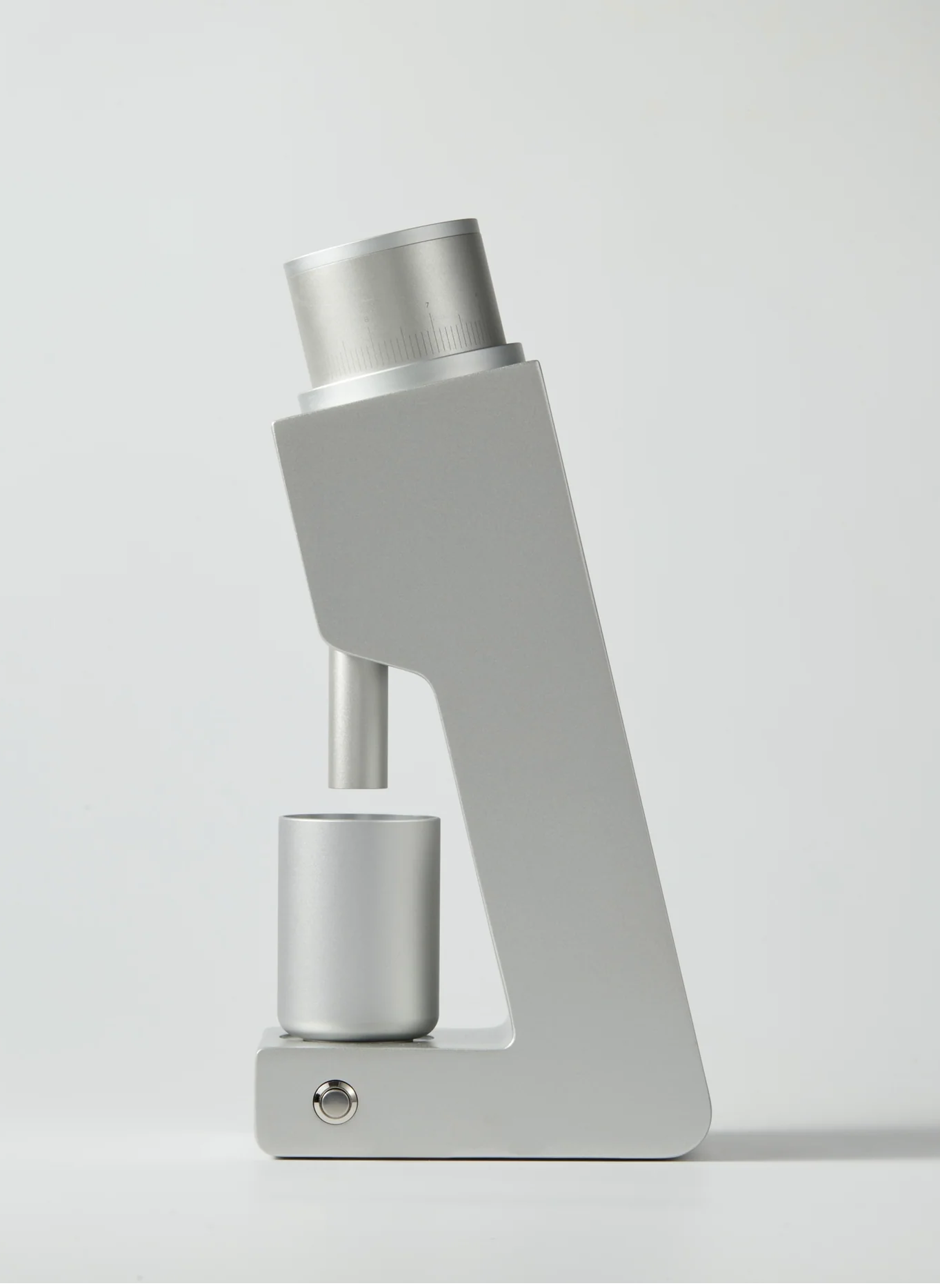
The ADC12 die-cast aluminum body is one of the most important structural elements of the VS3. Its rigidity prevents the drivetrain — motor, gearbox, and burrs — from flexing under load. Flex can introduce misalignment, vibration, and resonant frequencies that widen the grind distribution. By using a dense, stable metal chassis, the grinder minimizes these distortions, enabling the mechanical system to behave predictably over thousands of cycles. ADC12 also provides excellent heat dissipation, helping maintain thermal stability during longer grinding sessions. This matters directly for cup quality: when alignment stays true and temperature remains stable, the burrs maintain the same geometry shot after shot. For the user, the grinder feels solid, quiet, and anchored — qualities often associated with far more expensive machines.
Hopper and Workflow Design
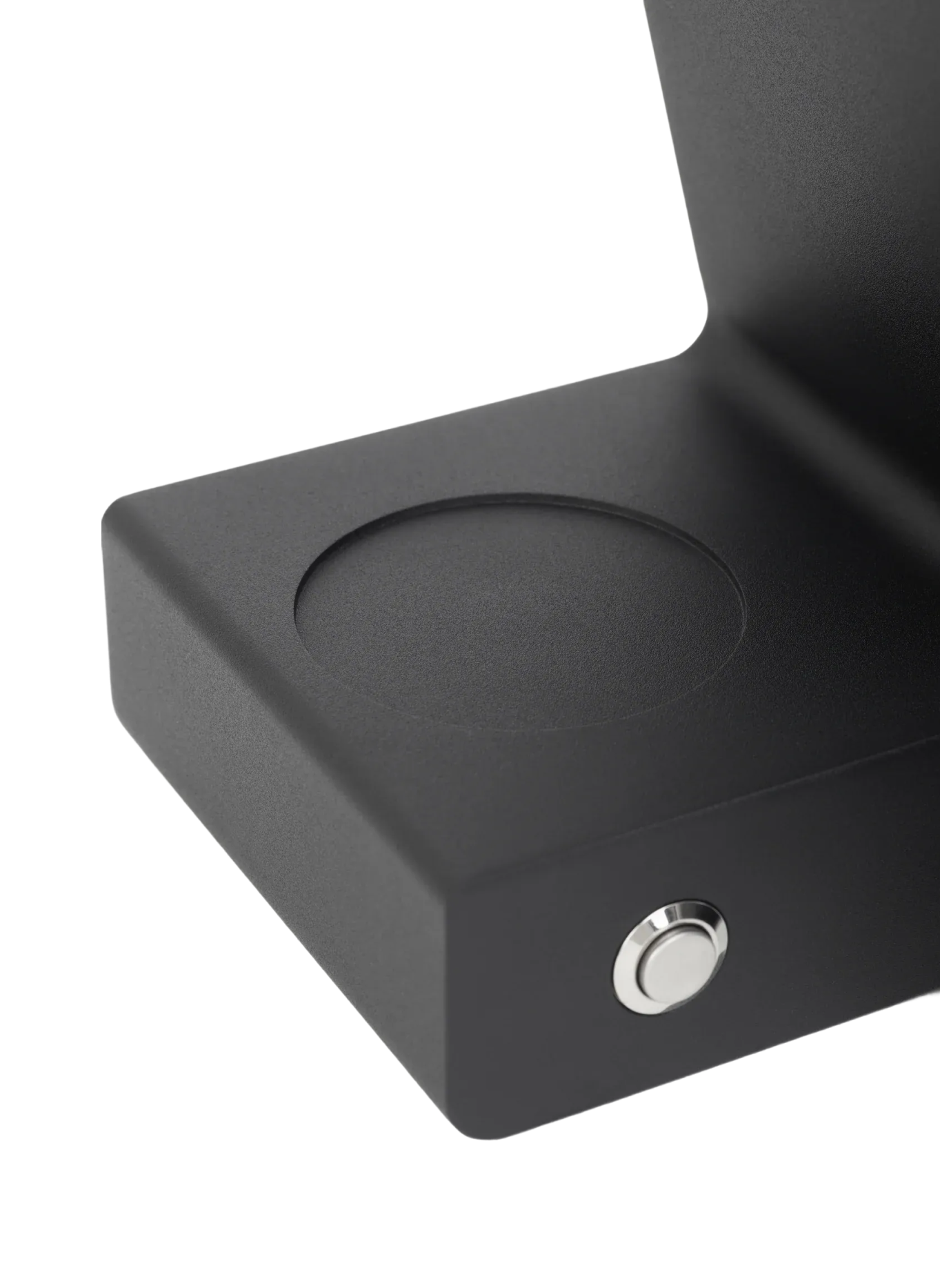
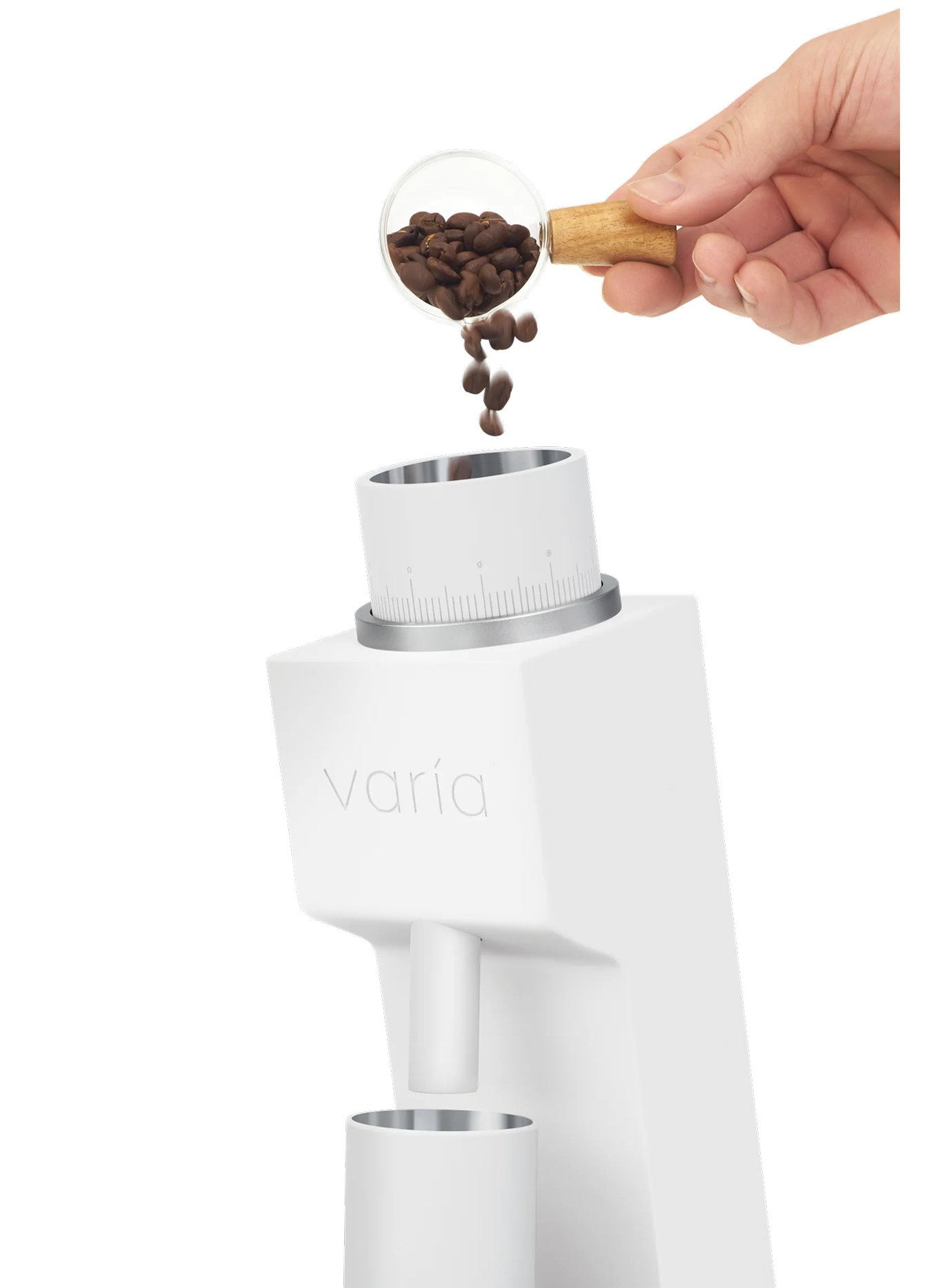
Designed for single-dosing, the 30 g hopper encourages a workflow centered around precision rather than bulk grinding. Its compact size reduces bean popcorning and supports a more controlled feed rate into the burrs. The silicone bellows serve as a functional extension of the low-retention architecture, allowing the user to dislodge residual chaff and encourage complete grind evacuation without introducing additional variables. Meanwhile, the magnetic dosing cup creates a seamless path from burrs to portafilter, aligning automatically and reducing spillage. This workflow design is not cosmetic; it shapes daily behavior. It makes the VS3 feel like an instrument you interact with intentionally, reinforcing consistency and cleanliness — essential qualities for anyone serious about espresso or filter craft.
RDT Tools & Cleaning Support
Including a 5 mL RDT spray bottle, spare parts, and cleaning tools signals that the grinder is built for long-term precision rather than short-term convenience. RDT (Ross Droplet Technique) prevents static, which is crucial for a grinder operating at low RPM, where particle velocity is low and static cling can easily disrupt workflow. Consistent use of RDT ensures grounds fall cleanly into the cup, reducing retention and improving dosing accuracy. The tools included support a maintenance philosophy: clean burrs, consistent workflow, predictable extraction. For the user, this creates a grinder that performs reliably not just when new, but after years of disciplined use.
Dimensions, Power & Weight
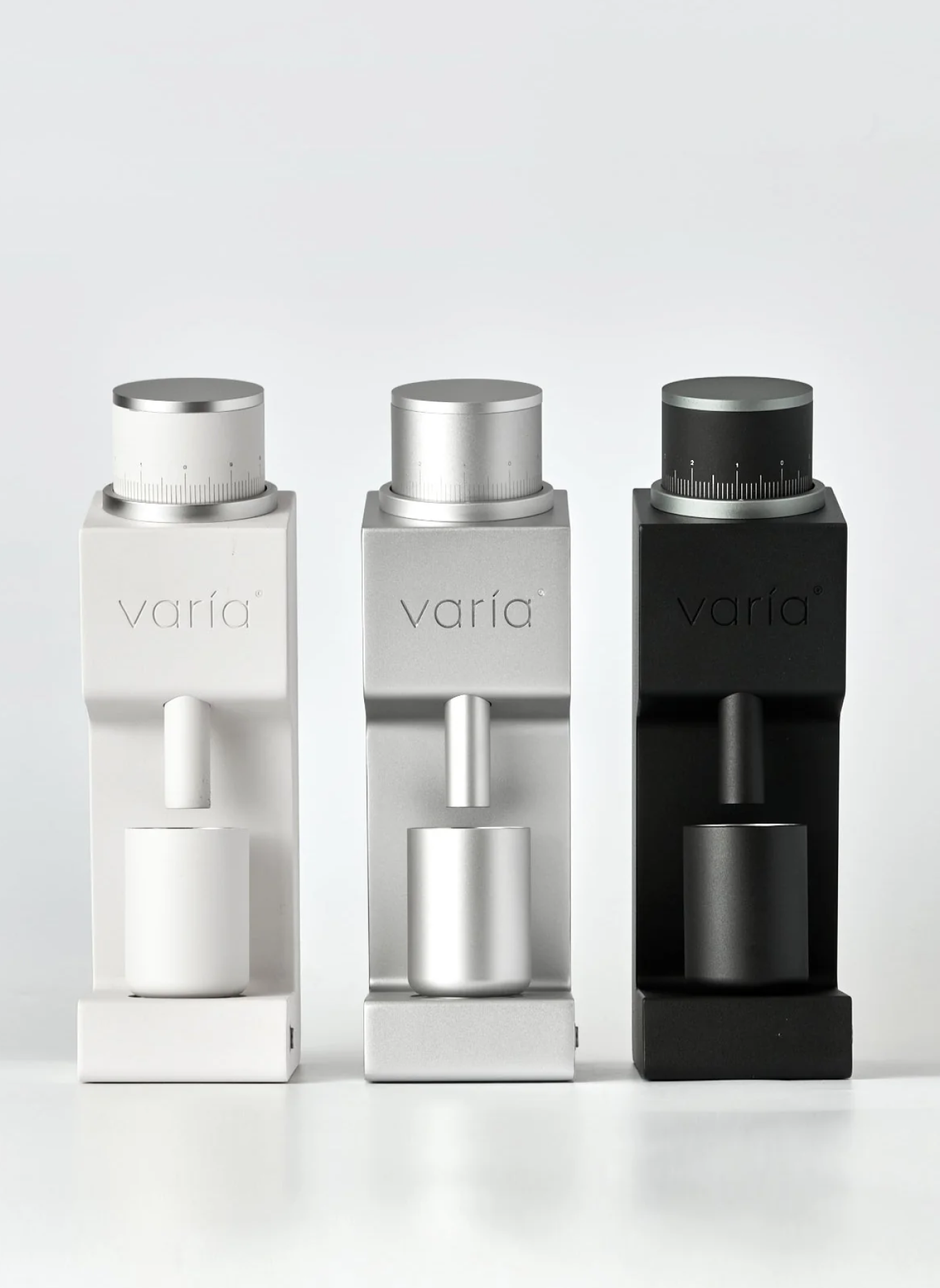
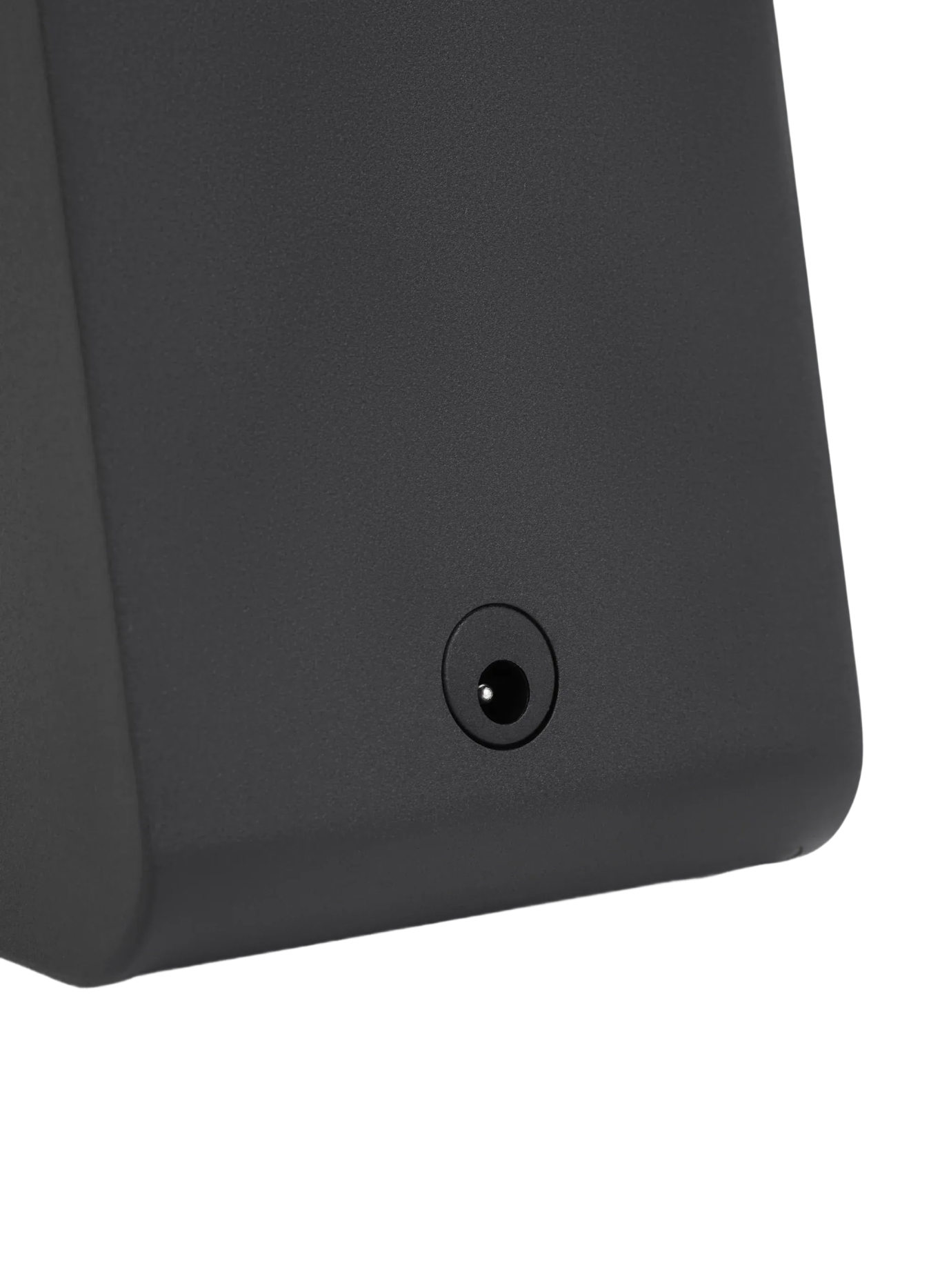
At 147 x 90 x 310 mm and 3.5 kg, the VS3 occupies minimal counter space while retaining enough mass to stabilize the grinding process. Lighter grinders tend to migrate, vibrate, or resonate under load, affecting alignment and noise. The VS3's weight anchors it, allowing the chassis to absorb operational forces without movement. Its universal 100–240 V compatibility reflects its design as a globally deployable precision tool. In daily use, this compact yet dense form factor makes the grinder feel exceptionally controlled: it stays in place, behaves predictably, and integrates easily into any brewing station without dominating the environment.
05
Varia VS3 Espresso & Filter Performance in Real-World Use
Real-World Performance
Disciplined Daily Use
Daily use of the VS3 is defined by consistency and feedback. The low-RPM motor stabilizes burr temperature, meaning the grinder does not drift across a session — a crucial factor for espresso precision. The stepless collar allows micro-adjustments that translate directly into shot behavior. If your shot runs fast or slow, the VS3 makes it easy to diagnose and correct because adjustments behave linearly rather than unpredictably. Single-dose workflow means no stale grounds and no purging, keeping your routine efficient. Over time, the grinder teaches you to read coffee: roast age, humidity responses, and minor dose changes all become visible through the grind. This clarity is what elevates the VS3 beyond convenience-driven grinders — it turns grinding into a precise, stable ritual.
Espresso Performance
For espresso, the VS3 excels in sweetness, textural density, and clarity. Conical burrs at low RPM produce a character that leans toward smooth viscosity with clean separation of flavors. Crema presence is robust without being excessive, and light roasts remain articulate without harshness. In practice, a few microns of adjustment can shift extraction noticeably, which is exactly what serious baristas want: a grinder that responds and repeats. Its slightly slower grind time is a deliberate choice — reduced heat preserves nuance, especially in modern light espresso profiles.
Filter Performance
For filter coffee, the grinder maintains impressive uniformity for a conical design, producing brews with open aromatics and balanced sweetness. The low-retention workflow is particularly useful for single-cup brewing, and grind adjustments behave predictably when switching between immersion, percolation, or hybrid methods. Even when moving between grind ranges, the alignment stability maintains particle distribution integrity.
Skill Development
Because the grinder does not mask errors, it becomes a long-term precision tool. Distribution flaws, dose variations, and workflow inconsistencies become visible. For users seeking mastery, this feedback loop accelerates learning: grind, adjust, taste, refine. The VS3 grows with you — the more disciplined your technique, the more consistent your cup becomes.
06
Varia VS3 vs Other Grinders
Comparisons
Varia VS3 vs Fellow Opus — Budget Espresso Grinder Comparison
The Fellow Opus is designed primarily for accessibility: lightweight construction, plastic framing, and a grinder philosophy oriented toward convenience rather than mechanical precision. It grinds quickly, switches easily between brew methods, and introduces beginners to the concept of controlled grind size — but its stepped adjustment mechanism and less rigid chassis limit its ability to hold extremely tight tolerances. For espresso, especially light roasts, the Opus requires more compensatory workflow corrections, because small adjustments translate less reliably into flow changes. The Varia VS3, in contrast, approaches grinding as a discipline. Its metal body, tightly machined tolerances, low-RPM motor, and stepless 10-micron adjustment system allow the user to work with a greater degree of control over particle geometry. This results in more consistent flow rates, reduced channeling, and higher repeatability shot after shot. The VS3 also maintains alignment more effectively over time due to its aluminum and stainless-steel construction — something the Opus cannot match. For the user, the trade-off is clear: the Opus is about ease and entry-level convenience, while the VS3 is about long-term craft, precision, and a more deliberate brewing experience. Beginners may appreciate the Opus, but those who want a grinder that reveals technique and scales with skill will find the VS3 a far more serious instrument.
Varia VS3 vs Niche Zero — Which Espresso Grinder Is Right for You?
The Niche Zero is famous for its 63 mm conical burr set, quiet operation, and warm, syrupy espresso profile. Its larger burrs generate strong torque and a grind character that emphasizes sweetness and viscosity — ideal for medium to darker roasts and for users prioritizing comforting, rounded extractions. Its workflow is smooth, its retention extremely low, and its build quality solid, making it a respected benchmark in the home barista community. The VS3, however, takes a different philosophical stance. Instead of prioritizing torque and body, it focuses on micro-adjustment control, low-speed clarity, and burr alignment stability. With its 48 mm conical burrs operating at low RPM and a stepless 10-micron mechanism, the VS3 allows users to fine-tune espresso extraction with more precision than the Niche Zero's coarser macro/micro dial system. Its grind distribution tends to yield more articulated flavors, especially in light roasts where the Niche can sometimes feel too rounded. The metal chassis and stainless-steel gearbox also give the VS3 an edge in maintaining alignment over time. For the user, the choice reflects taste and technique: the Niche Zero offers torque, sweetness, and ease, while the VS3 delivers precision, clarity, and a more analytical, dial-in–focused workflow. If the cup profile matters as much as the control, the VS3 may be the more revealing and disciplined tool.
Varia VS3 vs DF64 — Conical vs Flat Burrs for Espresso
The DF64 — a flat-burr grinder — is known for its power, its clarity-first cup profile, and its strong value proposition, especially in the modding community. Flat burrs inherently create a more uniform particle distribution with fewer fines, producing brews with pronounced separation and a "clean" taste structure. However, the DF64 requires careful alignment, can be louder, and often depends on aftermarket modifications (plugs, shims, declumpers) to reach its full potential. Its stock workflow can be messy, and static can be unpredictable depending on roast level. The VS3 stands apart because it arrives well-aligned, quieter, and mechanically stable without requiring user intervention or modification. Conical burrs at low RPM offer a different flavor experience — greater depth, more body, and smoother transitions between flavor notes — but the VS3 narrows the traditional gap between flat and conical by operating with unusually controlled torque and alignment. For espresso drinkers, especially those working with a variety of roast levels, the VS3 provides an easier dialing experience and more predictable behavior when switching between beans. From the user's point of view: the DF64 offers flat-burr clarity and raw power, but demands maintenance and tolerance for modding. The VS3 offers refinement, stability, and a more polished workflow with less friction and fewer variables to manage.
Varia VS3 vs Timemore Sculptor 064S — Manual Precision vs Smart Grinding
The Timemore Sculptor 064S represents a new generation of grinders that blend engineering with electronics, incorporating hybrid burr geometries, magnetic suspension systems, and high-speed motors regulated through software. These innovations create exceptional clarity and performance, but with increased reliance on sensors, electronics, and more complex internal structures. This gives the Sculptor an impressive level of modern precision, but also introduces more points of failure, higher maintenance complexity, and a workflow that depends on the longevity of electronic components. The VS3 situates itself on the opposite end of the spectrum: fully mechanical, intentionally simple, and built to be serviceable for a decade or more without dependency on firmware or electronic calibration. Its stainless-steel gearbox, die-cast chassis, and slow-RPM motor emphasize tactile feedback and predictable behavior rather than technological augmentation. For users who value long-term reliability, mechanical honesty, and a learning experience grounded in cause-and-effect rather than automation, the VS3 offers a more transparent relationship between adjustment and extraction. It fosters barista skill development because nothing is hidden: if the grind is off, the shot will tell you. The Sculptor is ideal for users who want cutting-edge performance with minimal manual effort. The VS3 is made for those who prefer mastery over automation, mechanical clarity over software-driven optimization, and durability over complexity.
07 Pros: it's the right grinder for you if you want for espresso brewing
08 Cons: be aware of the following before buying for espresso brewing
09 Is the Varia VS3 Worth Buying?
The Varia VS3 is not designed to impress through speed, automation, or convenience. It is built for users who understand that grinding is the first and most consequential act in espresso preparation — the one variable that determines how water interacts with coffee, how resistance forms in the puck, and ultimately how flavor emerges in the cup. The grinder's value becomes clear when viewed through this lens: it is a tool that elevates the discipline of dialing-in rather than bypassing it.
Because the VS3 emphasizes mechanical stability, alignment integrity, and micro-adjustability, it rewards users who want to refine technique over time. Its low-retention architecture encourages iterative brewing: dose, grind, pull, taste, adjust — a loop where every correction is accurately reflected in the next shot. This is a grinder that tells the truth: if your distribution is inconsistent, if your dose is off, if your extraction parameters drift, the VS3 will not compensate for you. Instead, it gives you a transparent view of cause and effect, which is exactly what cultivates real espresso mastery.
For users comfortable with manual involvement — measuring beans, applying RDT, single-dosing, adjusting grind size by feel — the VS3 becomes an extension of their workflow. Its slow RPM and conical burr geometry produce a cup profile that is both structured and expressive, especially with medium-light and light roasts. The grinder excels when the user seeks precision, clarity, and repeatability rather than speed or automation. Those willing to engage with the machine daily will find that it scales naturally with their skill: as your understanding of extraction deepens, the VS3 reveals more of what coffee can express.
On the other hand, the VS3 is not the ideal choice for users who prioritize convenience above all. It is not built for large batch grinding, high throughput, or hands-off operation. The workflow encourages intentionality — weighing beans, clearing retention, and adjusting grind regularly based on bean age and humidity. For some, this is a burden; for others, it is the core of the craft.
In practice, the VS3 occupies a rare position: a compact, durable, mechanically honest grinder that behaves like a precision instrument rather than a consumer appliance. For home baristas serious about long-term consistency, for users who want a grinder that makes their improvements measurable, and for anyone who values torque stability and alignment over wattage and RPM, the Varia VS3 is a compelling, long-lasting choice. It is a grinder that does not automate skill away — it amplifies it.
10 Complete Technical Specifications
11 FAQ — Common Questions About the Varia VS3
Is the Varia VS3 Good for Espresso?
Yes — and not just in a minimal sense. The VS3's 10-micron stepless adjustment system and stable vertical burr alignment make it capable of extremely fine control over flow rate, which is essential for modern espresso, especially with lighter roasts that require tighter grind tolerances. Because alignment remains consistent even when adjusting between settings, the grinder responds predictably to very small corrections. This means that when you change the grind slightly, you won't get erratic flow behavior or sudden jumps in extraction time — a common issue with grinders that have lateral play or stepped settings. For the user, this translates into a far more intuitive dialing process: taste, adjust, taste again, and see a clear, repeatable cause-and-effect relationship.
How Loud Is the Varia VS3 Grinder?
The VS3 operates more quietly than many flat-burr grinders thanks to its low RPM and rigid metal chassis, which helps dampen vibration. However, because it uses a direct-drive DC motor without the acoustic isolation found in some high-end commercial or studio-grade grinders, it is not completely silent. The sound signature is a controlled mechanical hum rather than a high-pitched whine. In daily use, most users find it unobtrusive — a sound that communicates torque and steadiness rather than harshness. For people accustomed to fast, high-RPM grinders, the VS3 will feel substantially quieter and calmer.
Is the Varia VS3 Good for Filter Coffee and Pour Over?
Yes. Conical burrs at low RPM often produce a particle distribution with a combination of clean clarity and a naturally rounded body, making them exceptionally versatile for filter brewing. The VS3's controlled torque and alignment stability reduce the production of fines compared to cheaper conical grinders, which enhances clarity and improves drawdown consistency in pour-overs. Users transitioning between espresso and filter will also appreciate how predictable the burrs behave when moving into coarser ranges — adjustments remain smooth and stable, rather than jumpy or erratic. The result is filter coffee that expresses aromatics clearly and maintains structural balance.
Do You Need to Use RDT with the Varia VS3?
While the grinder can be used without RDT, applying a very small mist of water is recommended, especially in dry climates or when grinding lightly roasted beans. Static electricity causes grounds to cling to surfaces and scatter, which reduces accuracy and retention performance. RDT (Ross Droplet Technique) neutralizes static, ensuring grounds exit the grinder cleanly and fall directly into the dosing cup. Because the VS3 is a single-dose grinder where retention precision is central to its value, RDT helps maintain the integrity of every dose. For users who prioritize workflow cleanliness and repeatability, it becomes an integral part of the routine.
How Often Should You Clean the Varia VS3 Grinder?
Light brushing after each session helps prevent oil buildup and keeps the burrs cutting cleanly. For deeper cleaning, once every 1–2 months is recommended depending on roast level: darker roasts shed more oils and residues, while lighter roasts leave fewer deposits. Cleaning extends burr life, preserves alignment, and stabilizes flavor expression. Because the VS3 is fully mechanical and designed to be opened without specialized tools, maintenance is simple and low-risk. Regular cleaning also helps you understand how coffee behaves at the burrs — an educational benefit for any user seeking mastery.
Can the Varia VS3 Grind Back-to-Back Doses for Espresso?
Yes, as long as the grinder remains within its rated cycle: 60 seconds of continuous grinding followed by 90 seconds of rest. At low RPM, the motor generates minimal heat, allowing it to maintain torque stability across several doses. For everyday home use — preparing multiple espressos or a few pour-overs in sequence — this performance envelope is more than sufficient. The gearbox stabilizes load transfer during repeated use, ensuring burr speed remains consistent across doses. For users serving guests or making multiple drinks in a session, the VS3 remains reliable and predictable.
Is the Varia VS3 a Good Grinder for Light Roasts?
Medium-light to light roasts benefit most from the VS3's slow-RPM precision, because these roasts often require tighter grind ranges and respond positively to low-heat grinding. The burr geometry brings out clarity and high-tone aromatics without muting acidity — a common issue with high-speed grinders that induce heat. However, medium and medium-dark roasts also perform well, producing smooth, balanced cups with good body. The grinder's neutrality means it does not impose an aggressive flavor signature of its own. Users who enjoy exploring seasonal coffees and single origins will find the VS3 especially rewarding.
How Long Do the Varia VS3 Burrs Last?
The 48 mm stainless-steel burr set is rated for approximately 150 kg of coffee. In a typical home environment, where users grind between 10 and 30 grams per day, this equates to several years — often 5 to 8 years or more. The hardened HRC58 steel maintains its cutting edges well, ensuring consistent particle geometry throughout the burr's lifespan. Because low-RPM grinding generates less heat and reduces friction wear, the VS3 tends to preserve burr sharpness longer than high-speed grinders. As burrs wear gradually, the grinder's consistency remains stable for a long time before any noticeable performance degradation.
Is the Varia VS3 Worth Buying in 2025?
Yes — in 2025, the Varia VS3 remains one of the most relevant single-dose grinders in its price range for serious home espresso. Its value does not come from novelty or electronics, but from mechanical fundamentals that do not age: stable burr alignment, low-RPM torque control, stepless 10-micron adjustment, and ultra-low retention. These are the same principles that define high-end grinders, simply scaled into a compact, disciplined format. As trends move toward automation and software-heavy designs, the VS3 stands out as a grinder that will not become obsolete through firmware dependence or electronic failure. Its fully mechanical architecture, stainless-steel gearbox, and rigid aluminum chassis make it a long-term tool rather than a disposable appliance. For users focused on skill development, repeatability, and mechanical reliability rather than speed or convenience, the VS3 continues to be a highly rational and durable investment in 2025.
Is the Varia VS3 Better Than the Fellow Opus for Espresso?
For espresso-focused users seeking precision and repeatability, the Varia VS3 is clearly the more capable grinder than the Fellow Opus. The Opus is designed primarily for accessibility and multi-brew versatility, using a stepped adjustment system and a lighter, more flexible internal structure. While it is convenient and approachable for beginners, it lacks the micro-adjustment resolution and alignment stability required for consistent light-roast espresso dialing. The VS3, by contrast, uses a true stepless 10-micron vertical adjustment mechanism paired with a rigid metal chassis and stainless-steel gearbox. This gives it far tighter control over flow rate and extraction behavior. In practice, small grind corrections translate directly into predictable shot changes, which is essential for mastering espresso. The Opus prioritizes ease of use; the VS3 prioritizes mechanical precision and long-term skill development. For espresso first, the VS3 is the superior tool.
Is the Varia VS3 a Good Budget Espresso Grinder?
Yes — the Varia VS3 is one of the strongest budget espresso grinders currently available for users who care about real grind accuracy rather than automation or speed. In the sub-$300–$350 category, most grinders rely on high RPM motors, plastic frames, and stepped adjustments that limit fine control. The VS3 breaks from this pattern by applying design principles normally reserved for far more expensive grinders: low-RPM torque-focused motor, rigid die-cast aluminum body, stainless-steel gearbox, and true stepless vertical adjustment. This combination allows it to produce stable particle geometry with low heat and minimal retention — exactly what modern espresso requires. While it does not compete with high-end grinders on throughput or convenience, it competes surprisingly close on grind discipline and alignment stability. For home baristas seeking the best budget single-dose espresso grinder built around mechanical integrity rather than marketing features, the VS3 is a genuinely serious option.
Who Should Buy the Varia VS3 Grinder?
The Varia VS3 is built for users who value control over convenience and repeatability over speed. It is ideal for home baristas who single-dose, weigh their beans, apply RDT, and actively dial in for each coffee. If your goal is to understand extraction, refine technique, and build a disciplined workflow where every variable is visible and adjustable, the VS3 fits that philosophy perfectly. It is especially well suited for espresso drinkers working with medium-light to light roasts who need tight grind tolerances and thermal stability. The VS3 is less appropriate for users seeking high throughput, batch grinding, or one-touch automation. It rewards attention and consistency, not hurry. In short, the VS3 is for users who want their grinder to behave like a precision instrument — one that scales with skill and makes progress in the cup measurable.
09/10

Grind
Consistency
10/10
Adjustment
Precision
09/10
Build Quality
& Durability
08/10
Low Retention
Performance
For Who is the Varia VS3 Espresso Grinder
-
Advanced home baristas seeking precision.
-
Espresso-focused users dialing modern roasts.
-
Single-dose, low-retention workflow enthusiasts.
-
Users who enjoy manual control.
-
Quiet, controlled grinding rituals.
Find where to buy Varia VS3
Apply to become a reseller

Varia VS3 Manufacturer
Varia is a precision coffee equipment manufacturer focused on creating mechanically transparent, durable grinders for home baristas who value control and consistency. Their design philosophy emphasizes low-RPM grinding, stepless adjustment, and metal construction — building tools that reward technique rather than automate it away.